Where Do Our Tax Dollars Go: A Case Study (Part 14) - What They Are Still Not Telling You
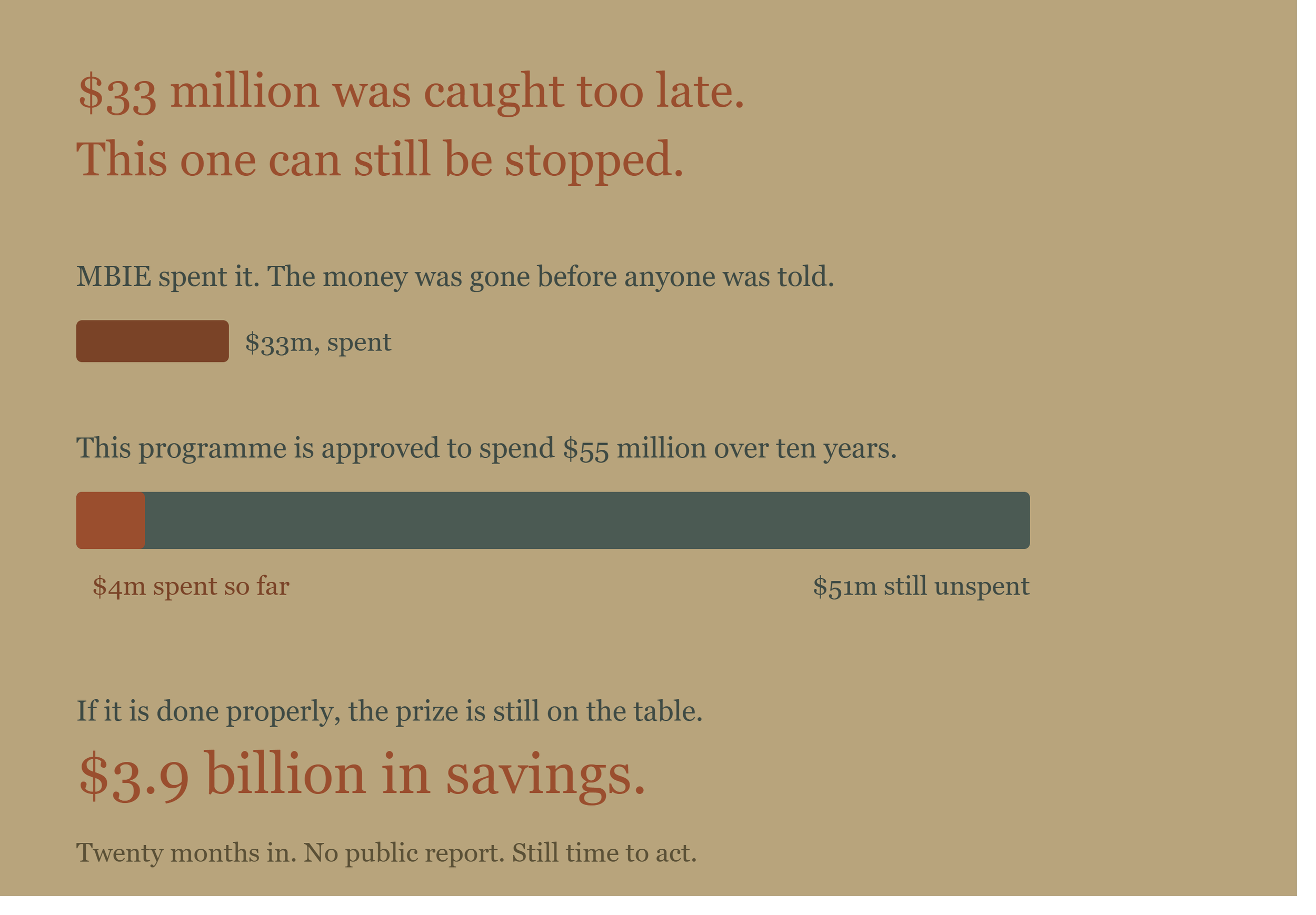
This one can still be stopped. The question is whether anyone will.
The views in this post are my own, based on my lived experience and personal recollection. My ERA proceedings against the Department of Internal Affairs are ongoing. All supporting documents and evidence will be disclosed through that process.
Last week, New Zealand learned that the Ministry of Business, Innovation and Employment (MBIE) spent $33 million on an immigration technology project that delivered nothing and kept ministers from knowing it. Winston Peters called it a conspiracy against the people and said those responsible should lose their jobs. Brian Roche, the Public Service Commissioner, went on record agreeing that people who mislead ministers were unlikely to remain employed in the public service.
Here is the irony. Brian Roche has been overseeing, since April 2026, a programme that promised to save New Zealand taxpayers $3.9 billion over five years. This programme has been running for twenty months and has not published a single progress report, a single milestone update, or any public account of what it has spent or what it has delivered. $33 million felt like a big number until you put it next to a programme that promised one hundred and eighteen times that amount in savings and has shown you nothing. If they had saved even a single dollar they could point to publicly, someone would have told you. Governments do not stay quiet about savings. The silence is the answer.
Those of you who have followed this series from Part 1 already know the team I am talking about. You have met Simon Dannefaerd, who told me on my first day that I had his job and spent the months that followed making sure the work did not get done. You have met Kylie Matson, who filed a formal misconduct complaint against me for asking her to do her job. You have met Andy James, who called a professional woman ‘a tit’ from his personal phone mid-meeting, and Fraser Buchanan, who told me he could not control himself when my hair touched his shoulder, and was then called as a witness against me. You have read about an institution that turned every formal process it had against the person raising concerns, while protecting the people those concerns were about.
There is a question this whole series has been moving toward. Why would they go to such lengths? What were they protecting?
These were not just difficult colleagues occupying government offices. They were the team responsible for delivering a Cabinet-mandated programme with a ten-year funding commitment, forty-two agencies directed to participate, thirty-two contributing funding, and a public promise of $3.9 billion in savings from a projected $13 billion technology spend across the New Zealand public sector. That programme now sits with the Public Service Commission, where Brian Roche has been its direct custodian since April 2026.
I started in this team on 13 January 2025. Within two weeks I was asking questions about what the programme was actually delivering and whether what was being reported upward reflected what was genuinely happening on the ground. That is why they came after me. Not because I was not doing my job. Because I was doing exactly what I was hired to do.
Let me show you what this programme has cost, in numbers that come from DIA’s own approved documents.
The Back-office Transformation Project business case, approved by DIA’s Project Review Board on 21 March 2024, sets out the funding in precise terms. The approved ongoing operational expenditure for the BoDTS and FMIS team is $3.45 million per year, every year, for ten years. That is $34.5 million in team costs alone over the life of the programme. On top of that, $550,000 per year for IT support, maintenance and infrastructure, and $1.2 million per year for back-office roles in the wider branch. Total ongoing cost approved in that document is $5.2 million per year. Whole of life cost for the entire programme is stated as $55.294 million.
That $3.45 million per year for the team comes from the proportional transfer model. The thirty-two agencies participating in this programme have been contributing to it. New Zealand Police is among the agencies mandated to participate. Their people have been in working groups. Their time and their contribution have gone into a programme that has produced nothing they can point to. And then Police went directly to the Government Electronic Tenders Service and procured SAP SuccessFactors for their HR and payroll systems, bypassing the mandated Marketplace pathway this programme was supposed to establish. That RFP is publicly visible on GETS right now, with delivery anticipated between February 2026 and September 2027. No one has explained publicly why the mandated pathway was not used. No one has explained what this programme was doing while one of its own contributing agencies went around it entirely.
The programme announced it had successfully delivered FMIS suppliers onto Marketplace. That was presented as a milestone achieved. So here are the questions that have not been answered publicly. Which agency has actually procured a back-office system through that Marketplace pathway? Where is the first implementation? What savings has it produced? The business case modelled $7.9 million in savings in the first year, building to $19.57 million in the second. The first year started in October 2024, and we are almost at the end of the second year. Where is that data? What have they produced? If these things exist, the public should be able to see them. Any member of the public can ask these questions directly through the Official Information Act - https://www.dia.govt.nz/Official-Information-Act-requests
Then there is the cost of how the team was actually operating on a daily basis. Azimuth, a Wellington consultancy, was engaged to provide Common Process Model expertise and ARIS process modelling support. The approved daily rate was $1,680 per day. The maximum spend approved for the initial engagement alone was $236,880 excluding GST. Azimuth was brought in because the permanent team needed specialist external support to deliver the scope. That is the stated justification in DIA's own Procurement Approval Memo. A team that could not deliver its own scope without paying outside consultants is the team now responsible for $3.9 billion in promised savings.
When the concerns about this programme reached the Public Service Commission, Brian Roche declined to engage with me and with my colleague, another person in a materially similar situation who has also been blocked from doing her job because she too raised questions about this team. He declined to meet with our advocate, and his HR team have essentially told us, I paraphrase, this is not their problem to solve. This is the same Brian Roche who went on record this week saying that people who mislead ministers should not keep their jobs in the public service. I would like to know when he is planning to fire the digital back-office transformation team in PSC for exactly the same behaviour. Or will he do what he did with his Code of Conduct and believe it is not applicable to him?
I have written about Brian Roche's Code of Conduct so I will not repeat what I have said before. I will say this though. A document without enforcement is not accountability. It is the appearance of accountability.
The ARIS platform, which hosts the Common Process Model used by over forty government agencies, costs $283,524.33 per annum in licensing fees paid to Software AG, excluding GST. That figure is in the approved business case. It has increased since then, as vendor contracts do, and currently sits above three hundred thousand dollars per year. This is the same vendor who conducted a health check of the ARIS system, which identified critical vulnerabilities. That health check report cost $12,000 and was subsequently removed from the SharePoint repository before senior leadership could look at it. In my view, it never made its way to the minister, something any member of the public can request through the Official Information Act. An earlier report prepared by Deloitte identifying risks in the ARIS environment was never shared with me or my team by the people who held it, despite its direct relevance to our governance responsibilities. You can probably estimate that report would have cost several times more than the health check done by the ARIS vendor. There are further costs connected to this programme that have not been made public, including the full value of all contractor engagements beyond what has been disclosed. These are also obtainable through OIA requests. Any of these costs should not need to be obtained that way, since responding to OIAs also takes effort from several teams and costs you tax dollars. They should be in the published reporting this programme has never produced.
By any conservative estimate, this programme has already spent well over four million dollars in the period since the team was stood up in October 2024. Against that, it has produced no measurable savings, no published milestone against the mandate, no useful strategy, and no benefit realisation framework.
Now here is the cost that has not yet been calculated.
The programme has been operating at level three of the Common Process Model. Level three is where agencies map their current processes. It produces documentation. It is not nothing, but it does not save money. The savings come from level four, where processes are standardised across agencies and the duplication is eliminated at scale. The Cabinet mandate required the programme to move agencies toward level four. The $3.9 billion promise was built entirely on that. A programme running at level three while carrying a level four promise is not behind schedule. It is delivering something categorically different from what the ministers and the public were told.
Brian Roche has given agencies until October to produce system level plans for the deeper savings the government is looking for. October is twelve weeks away. What would it actually take to move from where this programme is to where it was supposed to be? It would require knowledge of how to implement level four CPM that this team has not demonstrated it has. It would require the willingness to do that work, and twenty months of activity at level three suggests that willingness is not there either. This team has not produced a single document, a single framework, a single published methodology that shows they understand what level four implementation requires or how to get there. That inability is, in my view, the reason the October deadline will not be met.
The gap between digitisation and digitisation with standardisation that actually produces savings has been visible since the programme began. DIA went looking for someone who could see it and hired me as Manager Technical Operations for this programme. My twenty years of experience in IT transformations across the globe meant I saw the gap within weeks of starting. I raised it throughout my time there. What that led to is documented in the earlier parts of this series.
Winston Peters said last week that people who keep ministers from the truth should lose their jobs. He said it about a $33 million project. This programme has a whole of life cost of $55.294 million in DIA's own approved figures. It has operated without the risk reporting that ministers rely on. It has published nothing for ministers to evaluate against what was promised. It sits under the direct oversight of the man who endorsed that standard publicly while declining to meet the people who could have told him what was actually happening inside it.
The Public Service Commission is in the process of cutting nine thousand public sector jobs in the name of efficiency. This same organisation is running a programme that has spent those millions in twenty months and delivered nothing measurable.
The $3.9 billion was promised to you. It is still possible. But it will not come from a team that has spent twenty months hiding what it has not done. You now know that. The question is whether anyone who can do something about it will.
The bill for that answer will land where all the other bills have landed.
With the taxpayers of New Zealand.
With you.
