Where Do Our Tax Dollars Go: A Case Study (Part 5) - The Man In Every Room
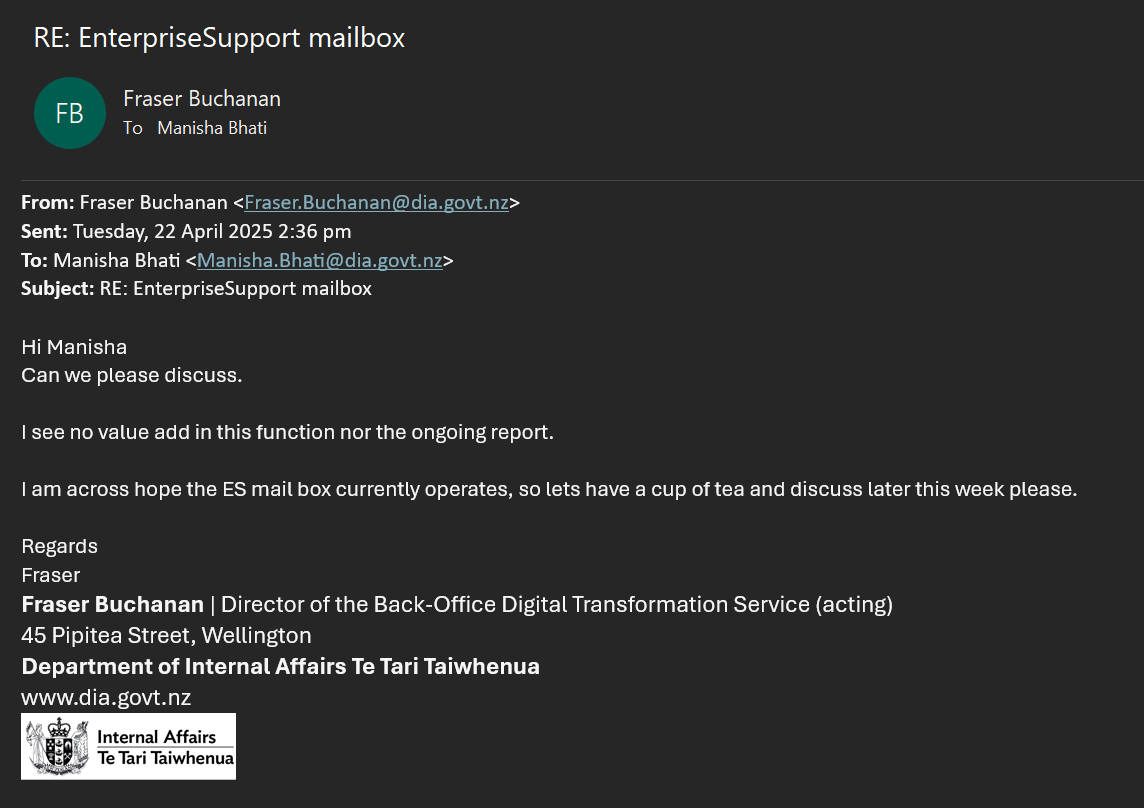
He managed to find time to dismiss my work by email. Same two weeks he said he was too busy to eat.
In my termination letter, dated 31 March 2026, DIA stated - "The allegations of sexual harassment against Fraser Buchanan were raised with us in correspondence in November 2025." In its Statement in Reply to the Employment Relations Authority, filed 5 May 2026, DIA went further, stating that "her comments indicated that she was unconcerned in that regard" and that "it was not until the 26 November 2025 personal grievance letter that the Applicant provided details of these alleged matters."It is a careful way of saying something very simple. She did not raise it at the time. Therefore, she must be lying. Or she must have been complicit.
It is a question that has echoed through every industry, every country, every era, asked so many times it no longer sounds like a question. It sounds like an answer. It sounds like a verdict. One that is almost always against a woman. Almost never asked of a man.
I am going to answer it. But the answer requires you to understand who Fraser Buchanan is. So let me tell you.
Fraser was the Manager of the Back Office Systems Operations and Engagement team at DIA. He sat at the same organisational level as me in the hierarchy. He was not my manager. But he was senior to me in other ways that mattered. He had spent many more years in New Zealand's public sector than I had. He knew its culture, its networks, its unwritten codes. I came from the private sector. I was newer to this country and newer to how things worked here. That difference was something he was aware of.
In my first weeks, he was one of the people who made me feel genuinely welcome. He was warm, collegial, and attentive. In an early email to the GM, I described him as someone who had gone out of his way to make me feel part of the team. I meant it at the time.
I am telling you that because DIA has already used it against me. Their formal response to the Employment Relations Authority quoted my own words back to me as evidence that I had not found Fraser's conduct troubling. What those words actually show is how harassment works in a professional environment.
There is substantial research on this, and I am not going to explain it to you myself. I would rather point you to people who have studied it far more rigorously. A peer reviewed study published in the journal Violence Against Women, titled "An Exploratory Investigation Into Women's Experience of Sexual Harassment in the Workplace," found that 80 percent of sexual harassment victims never report the incident, and that 72 percent of reported cases ended with the employer condoning, denying, or rationalising what happened. You can read it here: https://pmc.ncbi.nlm.nih.gov/articles/PMC10248292/
Fraser would regularly speak to me about Simon. He would say Simon was difficult, that he understood my frustrations, that Simon was not his friend despite what Simon seemed to think. He returned often to the subject of Simon's upcoming fiftieth birthday celebration, making a point of how uncomfortable he was about having been invited and how he needed to find a way to decline. I took these conversations at face value at the time. Looking back, I think he was managing me, not confiding in me. He was trying to understand how much I knew about the connection between them, beyond the fact that they had both come from Inland Revenue.
He also described Simon repeatedly as a genius. I want to be fair here and don’t completely dismiss a manager’s opinion. But as far as I am aware, Fraser had no technical background in the area. And Simon's genius had produced a platform that had operated for years without basic security controls and with governance failures I was by that point documenting in detail. No one else I worked with used that word about Simon.
I was informed by HR that Fraser had previously made a substantiated complaint against Simon, and that Simon had received a formal warning as a result. When I raised this with Fraser directly, he told me he did not recall making any such complaint. A manager does not forget a complaint he made against a colleague. A manager does not forget that it was substantiated. I did not find that explanation credible then, and I do not find it credible now.
Things changed when Andy went on leave. I have documented communication between us from that period where Fraser's tone shifted noticeably. He was issuing instructions on matters already resolved, as though reasserting his authority. When I tried on more than one occasion, both in writing and verbally, to raise this change in his manner directly with him, he deflected both attempts without engaging.
When Andy returned, I raised Fraser's behaviour with him. I shared the emails I wanted to discuss and invited him to a meeting. He did not turn up. I had thought we could resolve this between the three of us, a director and two managers, and remain cordial. Instead, shortly after that, both Andy and Fraser stopped communicating with me in any substantive way. In front of others, they would exchange pleasantries. Any real professional exchange had ended.
There was also a documented incident where Fraser contacted HR to say that I did not have the authority to manage Kylie Matson in the way I was attempting. He contacted HR in writing, without speaking to me directly, to challenge a management decision I had made.
He also blocked meetings I had been scheduling with external agencies. As I had begun building relationships across government and introducing those agencies to my team's work, those meetings were shut down. The agencies I had met with had responded positively. On more than one occasion, someone had told Fraser directly that they had found my explanations clear and my team's approach impressive. I cannot state his motivations as fact. I can state that the blocking happened, and I noticed the timing.
Then there was the call about Simon.
During a work conversation between me, Fraser, and another manager, I raised Simon's pattern of withholding information and misrepresenting facts. I said - my observation is that we cannot trust him, he lies. Fraser interrupted me. He said I should be very careful about using that word in a professional environment. Then he said - perhaps you do not understand the impact of that word, because English is not your first language.
These words came from the acting director. Fraser was covering Andy's role while Andy was on leave.
I have been speaking English since kindergarten. I did not say anything in that moment that was factually wrong. Fraser objected despite the fact that I had documented evidence of Simon being dishonest about several things. Evidence that existed in emails Fraser was part of, evidence I have shared multiple times during these events, evidence I raised with HR.
In my experience, that phrase “English is not your first language” is a weapon. It comes out when someone is trying to deflect you from the actual issue.
What I am about to describe is not easy to put into words. I am going to write the incidents plainly, one by one. What impact they had on me and why I didn’t say something, comes after. That part is something women across the world experience.
Incident one.
From early on, Fraser complimented me regularly. He told me I was pretty. He told me I was beautiful. He said I had a wonderful aura, that I was intelligent, that I was someone special. These were said in passing, often enough that I noticed. On at least two occasions that I clearly remember, he said that if we had been young at the same time, he would have pursued me. That I was someone he would not have let get away. Both times it was said on the open floor, casually, as though it was a straightforward compliment.
Incident two.
A colleague and I had a meeting scheduled. She had gone to get lunch so she could be back in time. As she was returning, she saw Fraser and me about to walk off together. She said: hey Manisha, I thought we had a meeting. Where are you two running off to? Fraser had asked me moments before if we could speak about something work related, and I had agreed. I was focused on explaining to my colleague that I was sorry and would reschedule. In that moment Fraser said something. I did not catch it. Later I asked my colleague what he had said. She told me he had said - be still my heart.
Incident three.
I was in a small meeting room with Fraser and two colleagues. It was a technical discussion. I was at the whiteboard, writing and explaining something. The room was small and the chairs were close to the board. My hair was down. As I moved while writing, my hair briefly touched Fraser's shoulder. I heard him say something but did not catch it clearly. I stopped and said: did anyone say something? Everyone shook their heads. I noticed the expression on one colleague's face and made a note to ask her afterward. When I did, she told me that when my hair touched his shoulder, Fraser had said: oh Manisha, it's so hard to control myself.
Incident four.
We were sitting at a small round table, just the two of us, working through something. I had my writing pad in front of me. In the middle of the conversation, Fraser said: you know, the other day you were wearing a shirt like the one you are wearing now, and the top button was open. I could see your supple skin. It was very exciting. Then he said something about his own age, about how skin like that was the benefit of being young. Supple. Smooth. I looked at him. I froze for a moment. Then I said - let's get back to work.
Incident five.
There was a video call with four of us. At the end of the call, I said I needed to get dressed and would see everyone at work. Fraser said he was going to say something and then immediately leave the call because I might get mad at him. He said that before saying it. He was telling me in advance that he knew I would not welcome what he was about to say. Then he said - Manisha, don't get dressed. And he logged off immediately.
I sat there. Then I asked the others still on the call: did he really say that? They laughed. They said yes, he did. They repeated it back to me. One of them added: Fraser really likes you. They kept laughing.
Incident six.
During lunch one day, Fraser made another comment. We were in a group and somehow the conversation had turned to first aid and what you would do if someone collapsed. We were talking about CPR. Fraser said he would never want to give mouth to mouth to just anyone. Then he said - Manisha is definitely allowed to do that if it ever happens to me. Only Manisha. No one else.
That was when I said to him - Fraser, you complimenting me about my looks is flattering, but I feel awkward because you are exactly my dad's age.
He brought that up at least three times over the following week, as though I had said something wrong. I asked a colleague why he kept bringing it up. She said he obviously had a crush on me and was hurt by that comment.
Incident seven.
On another occasion, in front of Andy James, Fraser said that he had the hots for me. Andy was present when those words were said. Andy laughed and said, "Oh I thought you liked me!"
Writing those seven incidents down made me feel violated all over again. What I am about to say is harder to write than the incidents themselves.
I understand what millions of women have felt before me. Women in every country, every industry, every era. Women whose names we know. The women who came forward about Harvey Weinstein, who had stayed silent for years while he continued to work, continued to be celebrated, continued to be protected by everyone around him. Anita Hill, who told the truth in 1991 and was asked by a United States senator: if what you say this man said to you occurred, why in God's name would you ever speak to a man like that the rest of your life? As though staying silent and continuing to function professionally was itself proof that nothing had happened. And the worst part is, this is so common it barely registers anymore.
Now let me respond to the question DIA put on the official record. Why did I not raise any of this at the time?
When something like this happens, you do not immediately think about filing a complaint. You run a very fast calculation in your head, usually in the same moment the comment is still in the air. You think about who this person is, how long they have been here, who they know, what they could do to your career. You think about whether anyone else heard it, whether anyone would believe you, whether it was bad enough to justify the consequences of saying something. You think about what happens to women who do say something. You have seen it. Everyone has seen it.
You also think about him. His wife. His children. His family. You think, he is someone's father. He is someone's husband. Maybe he does not even realise what he is doing. Maybe if I just set a clear boundary it will stop. And sometimes you set the boundary, the way I did when I told Fraser he was my father's age, and for a moment you think it worked. And then a week later you realise he is still talking about that boundary as though you wronged him by drawing it, and you understand that the boundary did not work, it just changed the shape of the problem.
You also think, it is not like he touched me. It is not like he grabbed me or cornered me or made an explicit proposition. These were words. Uncomfortable, unwelcome, professionally inappropriate words, but words. And somewhere in your mind is the voice that says, if you report words, they will ask you why it took so long. They will find the email where you called him warm and collegial. They will quote your own words back to you as evidence that you were not troubled enough to act. And you know, with absolute certainty, that this is exactly what will happen, because you have either lived it before or watched it happen to someone else.
So, you give a forced smile. Or a blank look. Or you say, hey, let's get back to work. And you move on, and you do not write it down, and you do not tell anyone, and you carry it quietly and you keep doing your job because that is what you came here to do.
DIA's formal response to the Employment Relations Authority described my silence as evidence that I was unconcerned. I want to ask one question in response to that. If a woman staying silent about harassment is evidence that it did not happen, and reporting it is used as evidence that she is difficult or unstable or lying, what exactly is the acceptable way for her to respond?
There is no acceptable way. That is the answer. The system is not designed to believe her. It is designed to make the cost of being believed too high to attempt.
Everything I was afraid of happened. Every calculation I had made in those moments, deciding to stay quiet, deciding to manage it myself, deciding it was not worth it, turned out to be correct. The personal grievance process, the letters from their lawyers, the responses filed in the Employment Relations Authority, all of it confirmed what I already knew. Not because I was wrong about what Fraser did. Because I was right about what the institution would do.
Fraser Buchanan was subsequently called as a witness in the external investigation into complaints made against me. My question is simple. Does anyone reading this believe he was a neutral witness? If not, the question worth asking is why DIA selected him.
There is also the question of cost to the taxpayer. My role at Department of Internal Affairs was in IT Band K. The salary range for that band is $166,725 to $207,480. Fraser's role sat at the same organisational level. Two managers, both in that band, both paid from public funds. One was dismissed after raising concerns about governance, bullying, and harassment. The other spent his time making comments about a colleague's skin, her cleavage, and whether she should get dressed, and was then called as a witness against her.
That is where your tax dollars went.
