Where Do Our Tax Dollars Go: A Case Study (Part 17) - Nobody’s Employee
The views in this post are my own, based on my lived experience and personal recollection. My ERA proceedings against the Department of Internal Affairs are ongoing. All supporting documents and evidence will be disclosed through that process.
I want to start with thanking the thousands of you who now come back to this website regularly. You read every part as it lands, you share it, and some of you have told me you wait for the next part to drop the way you would wait for the next episode of something you actually care about. That number keeps climbing every week, and what it means matters to me far more than the number itself. It means this story is reaching people. I hope it is giving some of the readers the courage to write their own. If you have a story like mine sitting unfinished in you, this website has a place for it. You can post it anonymously. Nobody needs your name to hear what happened to you. I promise you the anonymity is guaranteed.
I also want to thank those who noticed I had gone quiet for the past two or three weeks and wrote to ask if I was alright. Let me put your doubts at ease. I have not stopped and I do not intend to stop telling my story at least till this case is concluded. All of you will experience in real time what is happening with my ERA case and how flawed the system is and who might benefit from keeping the system broken. I will keep questioning where our tax dollars really go because not only is that my right as a New Zealander, but also it is the duty of the public service agencies to share that data with us. Our tax dollars should be spent to provide services to us, not to use the systems against us. Kiwis work hard and deserve to be treated with respect. When those in positions of power are not transparent, they are disrespecting each one of us.
I have a lot to write and not enough hours in a week to write it in since the public service agencies keep serving me content on a silver platter. However, I am also a mother and an author. The majority of my time in the past month has gone into a few things I have been building quietly on the side.
Coming back to today's story, which is about how the system erases a competent employee to create ‘nobody’s employee’.
Although I have mentioned this in other parts of the series, I will quickly provide some context. On 1 April 2026, a service called All-of-Government Services Delivery moved from the Department of Internal Affairs to the Public Service Commission. AoGSD was a whole service, with its own staff, its own budget line, its own place on an org chart, and on that date it changed hands. The decision to move it was made and signed off inside DIA, by its chief executive, Paul James, in advance of the date it took effect. My role, Manager Technical Operations, was named in that decision as one of the positions transferring with the service. However, there were two people holding the title Manager Technical Operations who were meant to transfer. Lisa Gibson had been acting in my role at DIA, and she moved with the team to PSC in that same role, without it ever being identified as an acting position.
On the afternoon of 31 March 2026, the letter confirming my dismissal arrived. On the morning of 1 April, the people still on AoGSD were due to start at the Public Service Commission.
A department that has already told its own people, in writing, that a service is transferring to another agency does not usually get to dismiss a person named in that transfer on its way out the door, particularly with an Employment Relations Authority matter into her treatment already open. The ordinary and cautious course, in every workplace I have worked in across three continents, is to leave things as they stand until a matter like that resolves. DIA had until the following morning, during which I remained, on paper, an employee it could ostensibly "discipline." And they used it. I have wondered about this several times since then. Why would they take an action which would be one of the clearest pieces of evidence of their retaliation against a whistleblower, someone who spoke up as their own policy allows, intending only to do her job well so that one of their most ambitious programmes would deliver the outcome it had promised.
AoGSD carried a promise wherever it went: $3.9 billion in savings over five years, the number the whole service was built to chase. I built the actual method for getting there after DIA let me go, on my own time, for nothing, and published it where nobody inside that building could quietly file it away. What I did not get to do was run that method inside the machine it was designed for. Somebody else is holding that machine now, at the Public Service Commission, and whether they know what they're holding is not something I can tell from here.
Going further back in the year, on 21 January 2026, a colleague and I filed a joint Statement of Problem with the Employment Relations Authority. We named the Secretary for the Department of Internal Affairs as respondent. We had worked in the same team. We had brought our concerns to the same Director and General Manager. I am certain you know them by now and all that happened in the back-office digital services team at DIA. We had raised the same concerns about the same people (Simon Dannefaerd and Kylie Matson) and watched the same response come back to each of us in turn. Filing separately never occurred to either of us. Why would it? We were describing one continuous pattern of conduct that happened to land on two different women, who were both competent in their respective roles and who could understand the potential risks and failure points of the programme itself. So, we told it as one story, because it was one story.
DIA's lawyers wrote to the Authority on 5 February 2026 asking for our two cases to be split apart. Their argument was that each of us was raising claims that were individual, tied to our own specific circumstances, and that how one of us had been treated was not relevant to whether the other had a case. They pointed to what they called complaints against me from two of my own direct reports, without mentioning that those complaints landed months after I had raised concerns about the same people, a timing I have already laid out earlier in this series and one their letter to the Authority never mentions. They also argued that the sexual harassment, racial harassment, and retaliation I was alleging did not, in their own words, appear to have any factual basis connecting to my colleague's claims. In my view, that connection is exactly what they were hoping nobody would look at too closely. My colleague was also being bullied. And she was watching what was happening to me too. And in my view, part of why she was targeted was because she supported me. Keeping our two cases apart meant nobody had to weigh that connection at all, and it meant nobody had to look at the whole picture, including the $3.9 billion in savings this programme promised and still has not delivered as expected.
On 21 April 2026, I filed my amended Statement of Problem, and reinstatement was one of the remedies I sought in it, alongside declarations that my dismissal was unjustified. It took another month before we filed something sharper. On 25 May 2026, my advocate lodged a formal Application for Interim Reinstatement with the Authority, asking it to hear the matter urgently and reinstate me to my role while the wider case continued. That application named the Public Service Commission, through its Chief Executive Sir Brian Roche, as a second respondent alongside DIA. The reasoning behind it was straightforward. DIA had already announced, in writing, that the service I worked on was moving to another agency. An Employment Relations Authority matter into how I had been treated was already open at the time DIA chose to dismiss me. The logical, reasonable position, in a situation like that, is to leave things exactly as they stand until the matter in front of the Authority has been resolved. DIA did not take that position. Instead, they argued there was no role left within DIA to reinstate me into, because whatever remained of it now sat inside the Public Service Commission.
Think of moving house and switching your power over to a new provider on the day you move in. The old provider can end your connection the day before the switch, for some reason unrelated to the move, timed so the new provider never actually receives a proper connection request. You flip the switch on move-in day and nothing happens. Call the old provider and they tell you, you are not our customer anymore, that is with the new people now. Call the new provider and they tell you, we have no record of any connection request for you. Both of them are telling you the truth. Neither one is lying. The only thing missing is any moment where the two of them were required to talk to each other, and the old provider chose the exact last moment it still held the switch, to make sure that moment never came.
That is what happened here, and it answers the question I asked earlier in this post. Why would DIA take an action that reads, on its own timeline, as one of the clearest pieces of evidence of retaliation against someone who had raised concerns they did not want raised? Because the timing was the only version of this that worked in their favour. Let the transfer happen cleanly, and my role, and everything I had raised, would have arrived intact at the Public Service Commission along with me. In simple terms, DIA would have knowingly transferred two managers, against whom sexual harassment allegations were still under investigation, into a new agency, while the woman who raised those allegations remained on leave, unresolved, months later. Dismiss her the day before instead, and neither institution ever has to answer for what happened to either of them. This is not incompetence. Anyone who has read this series long enough recognises it by now as a page from the Goonda playbook. Ignore genuine complaints, create confusion, and make sure the paperwork can always tell two innocent stories at once, or at least create enough doubt that the intentions can never be proven as retaliatory.
Two days after that application named the Commission as a respondent, its Chief People Officer, Amy Boldy, wrote back. She was replying to an earlier letter Allan had sent Sir Brian Roche on 18 May, and her letter, dated 27 May 2026, said this.
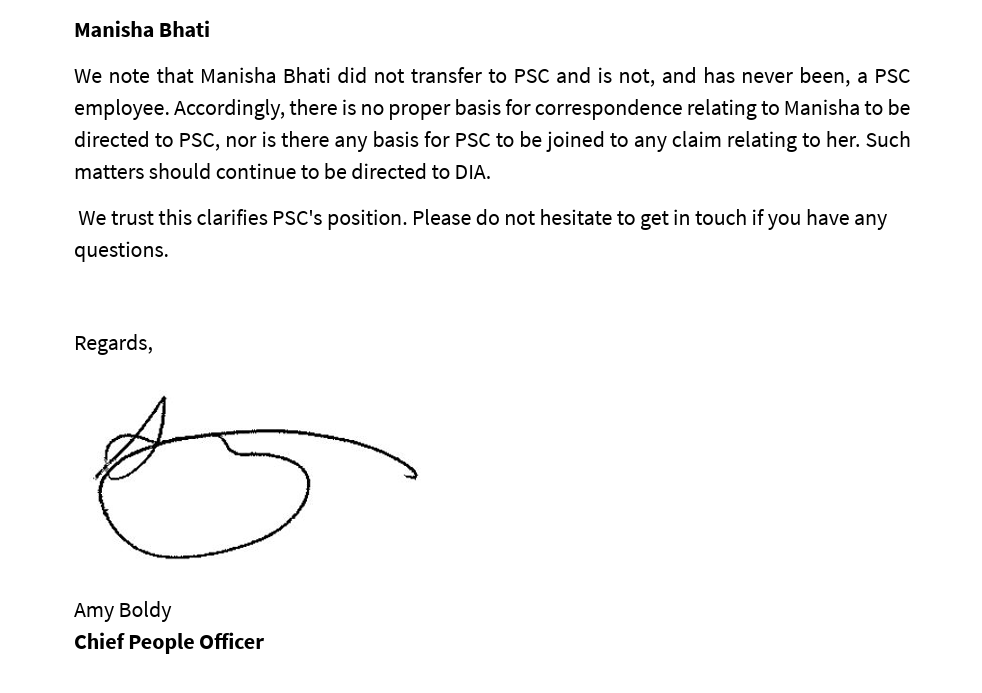
Two days. That is the entire gap between the Commission being named as a respondent in a live proceeding and the Commission's own Chief People Officer writing back to say there was no basis for it to be involved at all.
The Employee Relations Authority moved quickly regardless. Within days, it proposed dates for a case management conference and wrote to every party in the proceeding, asking the same simple question. When are you available? DIA's lawyers answered. So far as I have seen, the Public Service Commission's lawyers, sitting in that very same email thread, did not answer at all. Weeks have passed since. There is only silence from PSC.
This is exactly the kind of gap that keeps a case alive for months longer than it needs to be. Every extra month is another month of legal fees, another month of uncertainty, another month further from anyone actually deciding whose responsibility this was. I understand now why so many people give up before a case like this ever reaches a determination. Money runs out. Patience runs out. The gap between two doors is built to outlast both.
However, that was not the Commission's first opportunity to know who I was.
On 9 October 2025, five months before any of this reached the Authority, I wrote directly to the Public Service Commissioner. My email opened like this.

The complaint itself concerned the PSA, the union that was supposed to represent me, and how its organiser had handled matters connected to my employment at DIA. (Note that the article on PSA’s role is coming up too).
The Commission's Enquiries team replied as below:
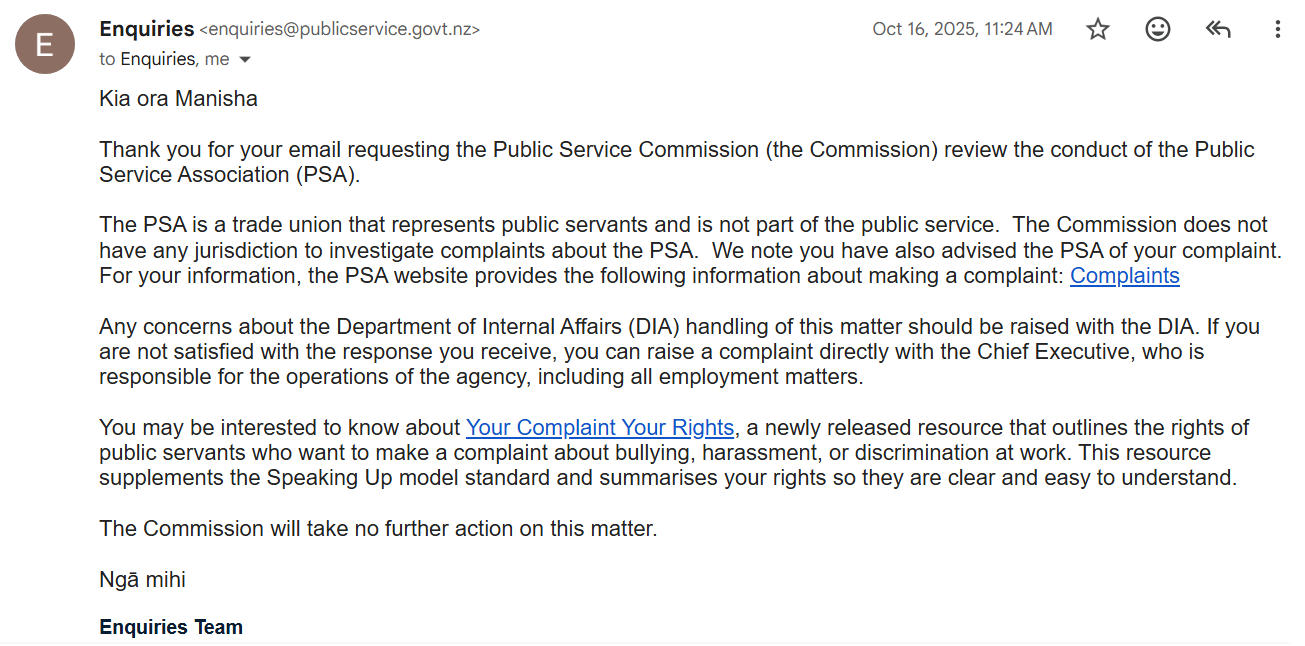
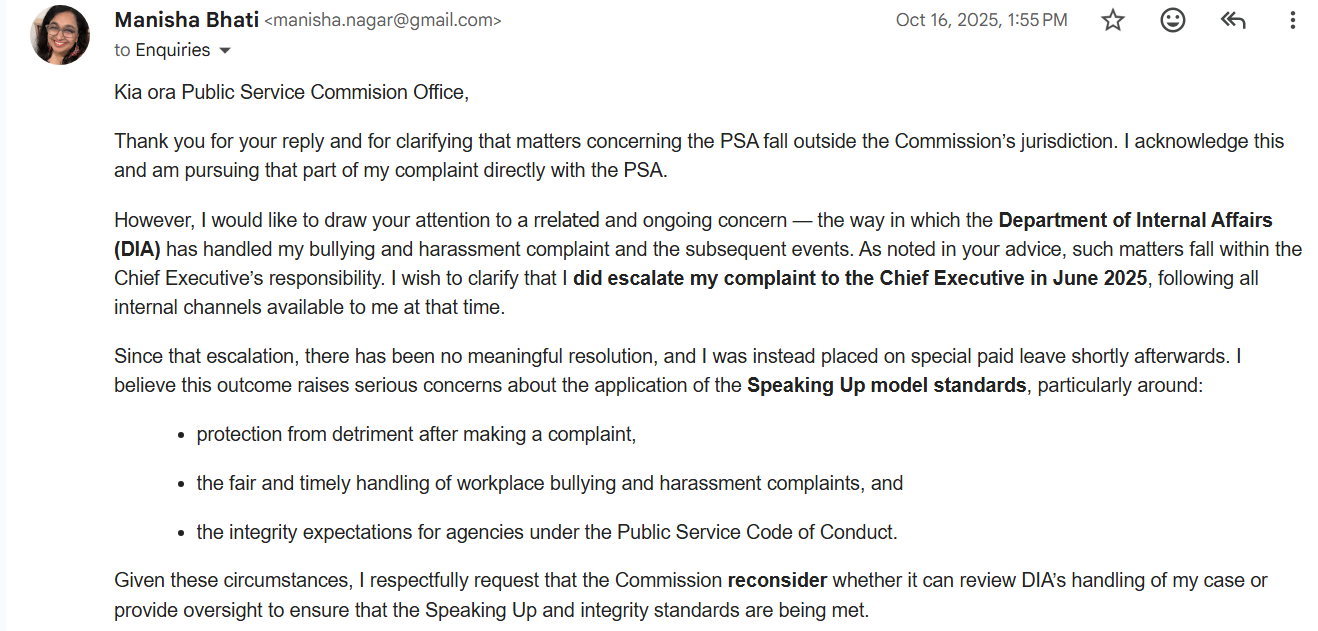
I wrote back the same day reminding them I already gone to DIA's chief executive, in June 2025, following every internal channel available to me at the time, and that since that escalation there had been retaliatory actions against me. I asked whether the Commission would reconsider reviewing how DIA had handled my case, given what I understood the Speaking Up model standards to require. On 29 October, having heard nothing, I wrote again, asking whether the matter was even being evaluated, and noting that I remained on special leave, without clarity from DIA, for more than four months by that point.
The Commission answered on 4 November.
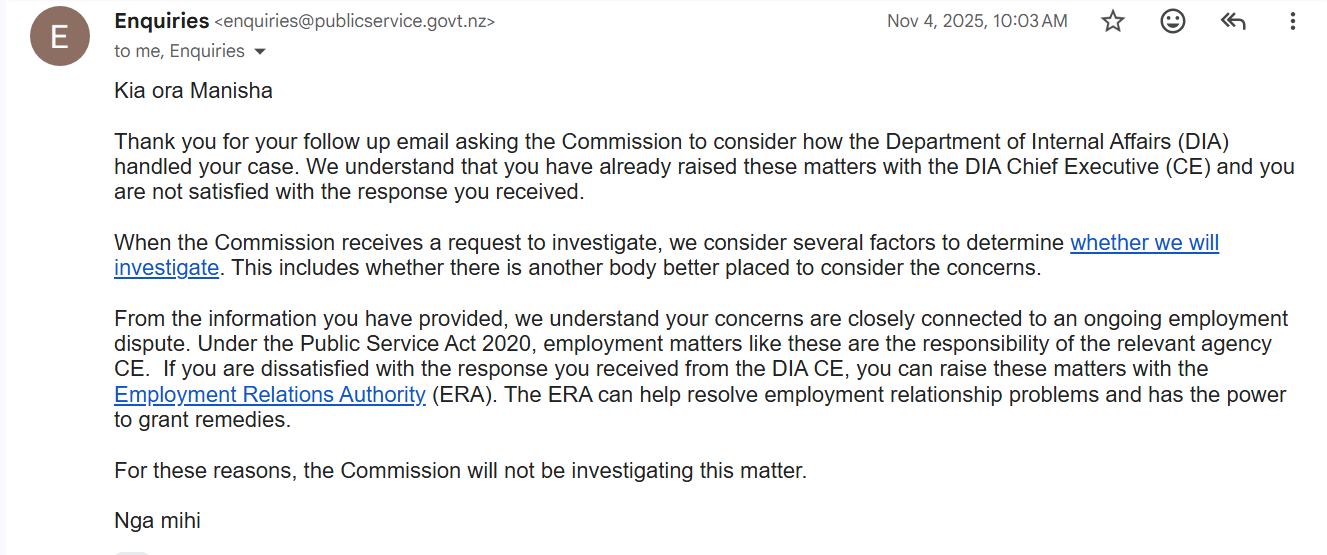
I wrote back on 6 November and said plainly that what I was raising was not an employment disagreement, that it involved documented bullying, racial discrimination, and retaliatory complaints against the only woman manager of colour on my team, and that these went to the heart of what a safe and ethical public service workplace is supposed to look like. Then I asked the question I still think is the right one to ask.
I asked whether the Commission would rather wait until cases like mine surface publicly years later, the way some of its other cases have. Shouldn't they want to resolve things while they're happening, not after the fact.
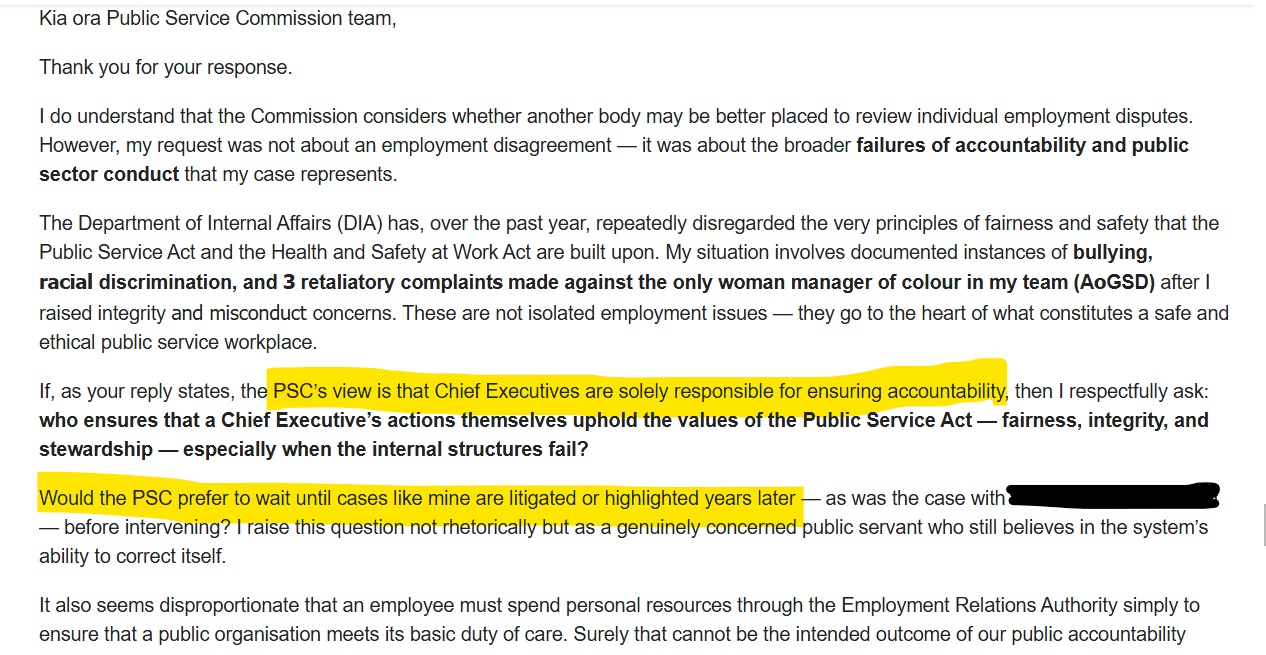
The Commission's final reply came on 24 November. It set out its own internal criteria for when it chooses to investigate and applied that framework to my case.
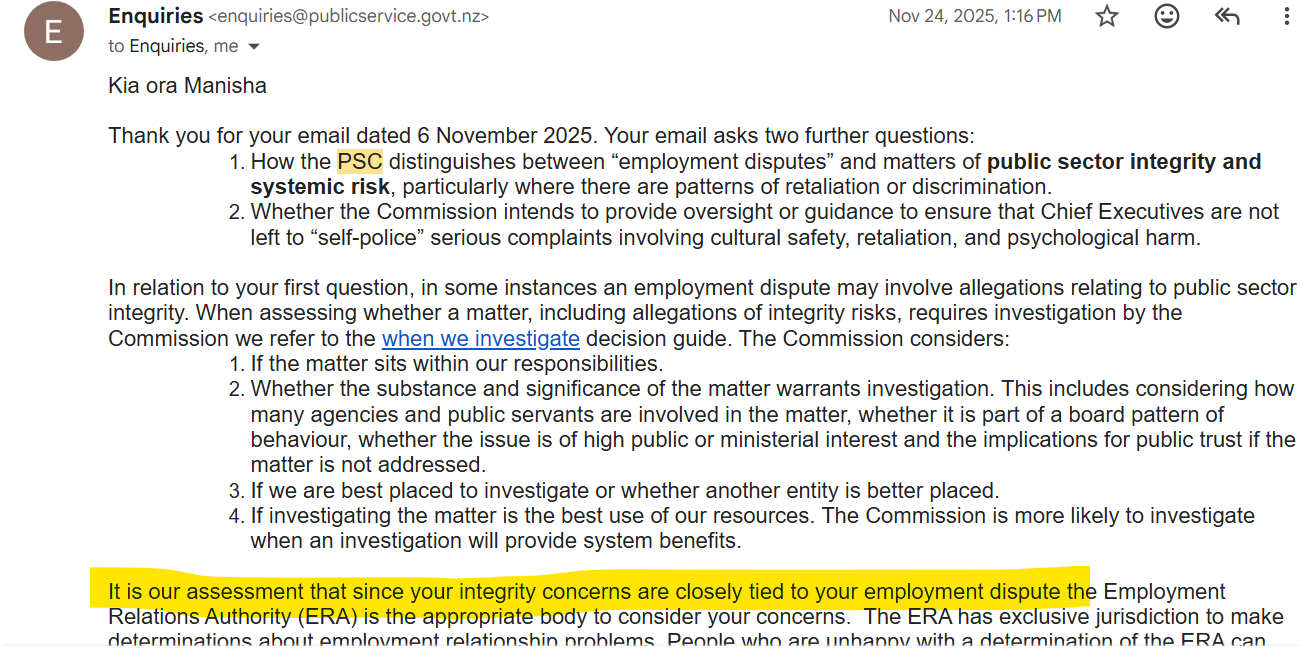
It pointed me, as something of a consolation, toward the Speaking Up and Positive and Safe Workplace model standards the Commissioner himself had issued - https://www.publicservice.govt.nz/role-and-purpose/integrity-and-conduct/model-standards.
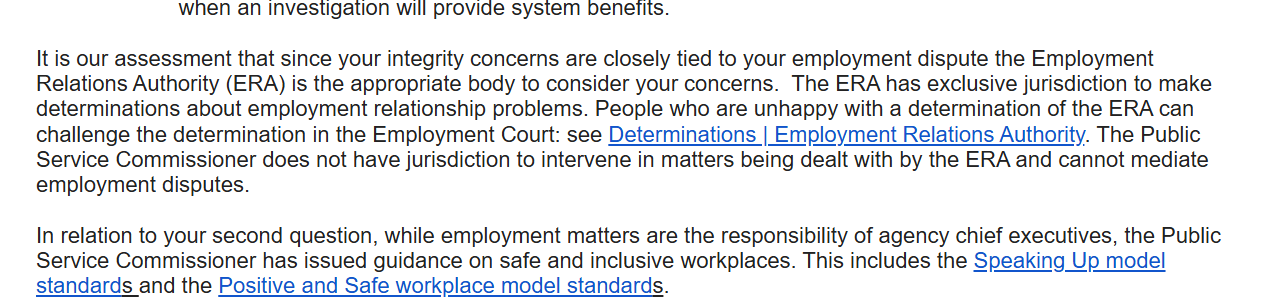
Four emails over seven weeks, from an office that this exchange had opened by addressing its Commissioner personally, by name, quoting his own public words on integrity back at him as the reason for writing. The whole of it was reduced to two instructions. Go to your chief executive. Then go to the Authority.
By the time Amy Boldy wrote to Allan in May 2026 to say there was no proper basis for correspondence relating to me to be directed to PSC, the Commission had already corresponded with me about matters connected to DIA's conduct four times, seven months earlier, starting with an email addressed personally to its own Commissioner. Her letter did not mention that history.
Yet nothing in what she wrote was technically false. I had never transferred to PSC. There had never been a personal grievance raised against PSC specifically. But there had been correspondence, real replies, a real paper trail showing the Commission already knew exactly who I was and what I was raising, seven months before anyone suggested joining it to a claim. Somewhere between November 2025 and May 2026, that history became something the Commission's own letters no longer needed to remember.
Sir Brian Roche is not a bystander in the system his office kept pointing me back into. Under the Public Service Act 2020, the Commissioner appoints Public Service chief executives and reviews their performance. He is, in the plainest sense, their employer. When his office told me that employment matters like mine were the Chief Executive's responsibility, it was routing my complaint about a Chief Executive's own department back toward the very person the Commissioner appoints, pays, and is meant to hold to account.
It goes further than that. The Public Service Commission administers the Protected Disclosures (Protection of Whistleblowers) Act 2022, and it is itself one of the bodies the law names as an appropriate authority to receive a protected disclosure about serious wrongdoing in the public service. I am a whistleblower. What I raised with his office in 2025 may never have been lodged under that formal heading, but in substance it was exactly that. Serious wrongdoing, documented, dated, sent in writing to the one office in the country whose job is to receive it. His office had a door built for precisely this. Four times, it pointed me toward a different one instead, always ending at the two instructions you have already read in this post. Go to your chief executive. Then go to the Authority.
This is the same man who has spent his tenure speaking publicly about integrity, writing the code of conduct the rest of the public service is measured against, telling the country that agencies should hold the line on standards meant to protect the people they serve. I have read those speeches. I have also read what his own office sent me, four times, in writing, and I cannot make the two sit comfortably next to each other. When my advocate went back to his office a second time, seven months later, this time by naming him personally as a respondent in a live legal proceeding, the pattern held. The answer came back from his Chief People Officer, and it said, in effect, that none of this was ever properly his to answer for either. I am curious why the Chief People Officer would be involved in this matter unless there was a trail of interactions which we are not aware of.
Let me explain the mechanism of transfer of one team from Organisation A to Organisation B in simple terms.
A transfer like this does not happen on the morning it takes effect. Weeks or perhaps even months earlier, someone has to build a list. Every name on it needs a login created, a system permission granted, a laptop configured, a security clearance checked, an email address moved across or set up fresh. None of that gets arranged on the day people start work at a new organisation. It gets arranged well before, in a document somebody senior enough has to sign off on, because if a name is missing, or access goes to the wrong person, somebody has to answer for it.
That is what should have happened here. In an official document, my role, Manager Technical Operations, was named as transferring to the Public Service Commission with the rest of AoGSD. It was not marked vacant. It was not flagged as unfilled. It was identified as transferring to PSC. Yet it must be showing vacant in the Commission's own HR records now. Did nobody at PSC notice that gap? Did nobody think to ask DIA to explain it? A named role that never shows up on payroll, in a system, or at a desk is exactly the kind of gap a Chief People Officer's office is positioned to catch, among everything else that job covers. But she must have looked before responding to my advocate, you ask. After all, she could find what she needed to deny involvement.
Which means a trail should exist. Somewhere between the transfer document naming my role and today, there should be an email, a query, a note, something showing someone asked the question.
If I lodge a Privacy Act request for everything the Commission holds under my name, there are only two possible answers, and neither one is comfortable for them. If the record shows they had it all along, my complaints, the role that was meant to transfer to them, my name attached to every letter I sent Sir Brian Roche personally in 2025, then the Commission has known exactly who I was this entire time, and every month its lawyers have failed to answer a simple scheduling question in my case stops looking like oversight. It starts looking like a whistleblower being left to wait, deliberately, while the one office in the country built to receive exactly this complaint sat on what it already knew, delaying a hearing it has every reason to want delayed, keeping my case from moving, keeping reinstatement further away with each month that passes. That is not neutrality. That is harm, delivered slowly enough that nobody has to call it that, under a man who holds the title Sir and has spent his career telling the rest of the public service what a code of conduct requires of them.
If instead the record shows nothing at all, no complaints, no name, no file, that tells me DIA had already made its decision about me weeks before it ever put my dismissal in writing, while still telling me, and telling my advocate, in official correspondence, that my role would transfer. I am left wondering whether Richard Ashworth's official communications with me were entirely accurate, and whether the HR at DIA approved of it. I have similar concerns about the PSC HR communication as well.
As you must have noticed, I have been tagging PSC throughout this series. I cannot tag Brian Roche because he is not on LinkedIn. There has been no attempt from his office to communicate with me or show any interest in my grievance. In my opinion, their position in a nutshell has been that they don’t care. Since Brian Roche or his office won’t respond to any other approach by my advocate, I will ask some questions in this public forum directly to him. And I invite him to respond to them publicly for everyone to see.
Sir Brian Roche, why are you not held to the standards you require of everyone beneath you, the same code you wrote for them? You have spent your tenure lecturing this country on integrity, writing the code of conduct the rest of the public service is measured against, telling agencies to hold the line on standards meant to protect the people they serve. What was the point of writing it, if you never have to meet it yourself? Should you not be leading by example? And since you are also a CE accountable to uphold the standards in your own organization, which doesn’t seem to be happening, how are you expecting any other CE to do so, simply because you asked?
Four men sit somewhere in this chain, Paul James, Richard Ashworth, Andy James, and you. Taxpayers fund every one of your salaries at a level most Kiwis will never see in their working lives. Is this what you believe compliance of the code of conduct should look like? If not, what are you going to do about it?
Readers, I wonder if I am the only one that is unable to reconcile how hypocritic and dishonest this is for any public servant.
There is one thing I will leave with you. We ask professionals in every serious field to renew their standing. Doctors, lawyers, accountants, all of them requalify on a regular cycle, all of them prove they still meet the standard the title implies. A knighthood does not face that same renewal cycle, one requiring the holder to prove, again and again, that it still fits who they have become. It can be revoked, but only in extreme cases, and otherwise it is awarded once, for what someone did or was believed to represent at the time, and carried for the rest of their life regardless of what they do in the role afterward.
Sir Brian Roche earned his knighthood before any of this happened, for work I have no reason to dispute was good. My question is not about the past. It is about whether a title like that should keep meaning something in the present, continuously, the way a licence to practice does, rather than being earned once and worn forever, unreviewed. I would be curious to know what you think. If you have thoughts on this, please feel free to comment on LinkedIn.
