Where Do Our Tax Dollars Go: A Case Study (Part 20) - The (In)Human Resources Manager
Disclaimer: The views in this post are my own, based on my lived experience and personal recollection. My ERA proceedings against the Department of Internal Affairs are ongoing. All supporting documents and evidence will be disclosed through that process.
Have you ever heard of an accused person being acquitted of a crime because he denied it? Or a perpetrator claiming he could not have committed the crime because he is not attracted to the victim’s body type or ethnicity? The second of those could reasonably be called a hate crime in itself. Would it not?
If you were on the jury in a murder trial, and the accused’s defence was that the gun used in the murder was not the type he prefers, would you conclude he could not have been guilty? Or if the accused said, in hindsight, that he believed the victim had probably been planning to kill him, would you return a “not guilty” verdict?
Well, if you are reading this and thinking what kind of absurd questions these are, you will perhaps be more confused when you read two letters I received from DIA over the past month.
I have heard a lot about how every sexual harassment complaint becomes a “he said, she said” issue, despite the fact that statistics say a woman is more likely to be telling the truth. If you think of all the people you know, you can probably think of at least one person who sexually harassed a woman, but you would probably not be able to think of a woman who wrongly accused someone of such a crime. Most women would rather not report it or talk about it, simply because people around them do not believe them.
But I spoke up. I reported. Because I was not left any choice. I reported Andy James because he used a private note against me. I provided the evidence of his WhatsApp and text conversations as part of my response to his complaint. Read about this in Part 2 of the series Andy James, Richard Ashworth & DIA: Case Study Part 2 | Voices@WorkNZ — Voices@WorkNZ.
The Department called the contents of that note threatening, behaviour with the potential to amount to harassment of Mr James. If that is true, if my private note was serious enough to warrant a formal process, an investigator, and eventually my job loss, I would like to know why he carried something threatening around in his bag, the same bag he brought into work every single day, for six weeks, before anyone heard about it.
I never made a formal complaint against Fraser Buchanan until Richard Ashworth pushed me toward one. When I named Fraser as someone who might have witnessed what Andy James said to me and my lawyer expressed concern if Fraser will tell the truth, Richard told my lawyer that Fraser was a man of honour and would tell the truth. She then told Richard how Fraser himself had behaved toward me. That exchange is the reason a complaint against Fraser existed at all. Read what happened in Part 5 of this series Fraser Buchanan, Simon Dannefaerd & Andy James: DIA Case Study Part 5 — Voices@WorkNZ.
Coming back to the letters from DIA (full letter available here), the General Manager Human Resources Simon George treats a man’s denial, and any reason for it however absurd, as proof enough of his innocence. A woman’s detailed denial, her offer of witnesses, her offer of evidence, is not enough to find her innocent, according to the same Mr George. A single reference to a Hindu goddess in a private note was, on its own, treated as enough. Had I still been an employee, the letter says the Department would likely have investigated me for serious misconduct over it. And regardless of that likelihood, the letter is explicit on one point with no hedging at all. These findings, on the diary, on Andy James, and on Fraser Buchanan, are going onto my personnel file as a formal record, whether or not any of it was ever actually investigated to a conclusion.
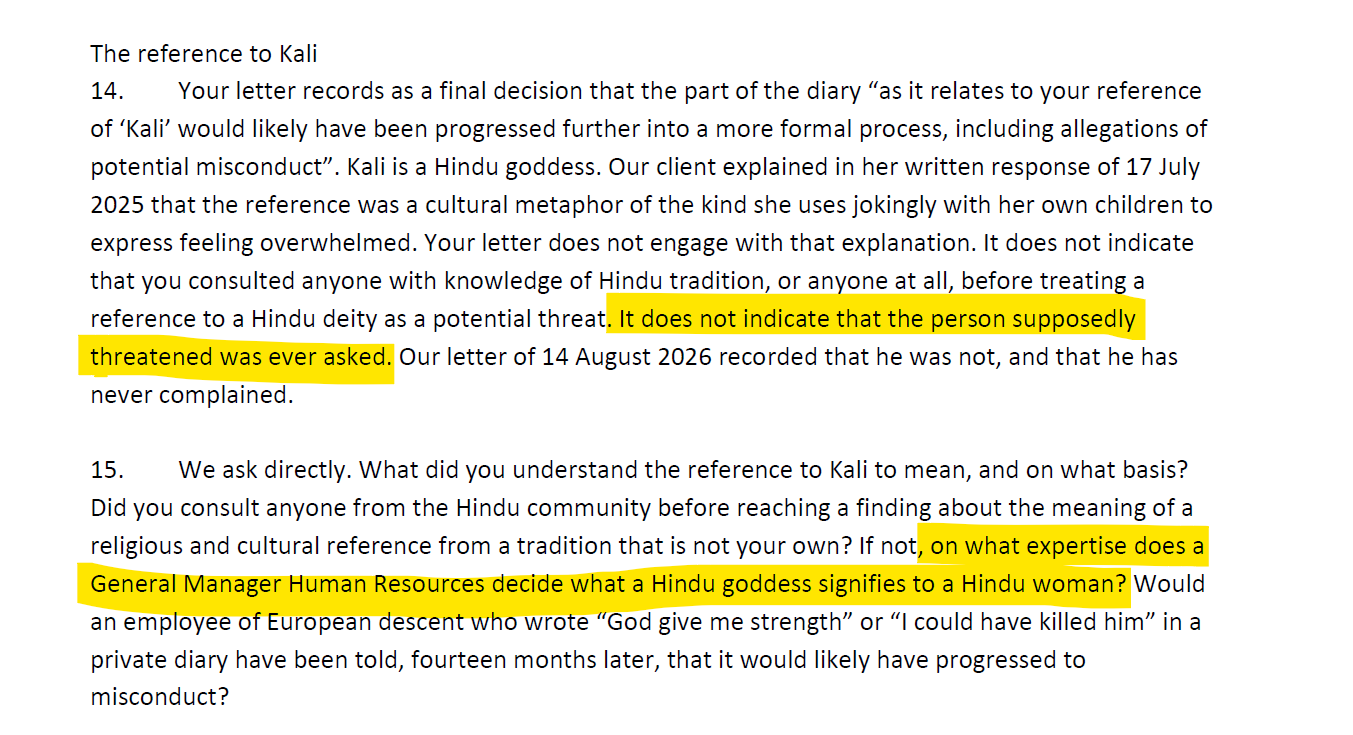
Maybe it is because of my ethnicity and body shape, to borrow Fraser Buchanan’s words. If you are reading this and thinking what could possibly provoke this man in his late 60s, exactly my dad’s age, to have used those words to describe me, that was part of his defence in the sexual harassment complaint filed by me. Not only did he think it was an excellent defence, the Department of Internal Affairs’ GM Human Resources thought it was convincing enough to put it in an official letter sent to my advocate. When I read his letters, all I could think was, how can someone put this on the letterhead of a public service department, and put their signature on it? Richard Ashworth’s fact finding sits underneath the letter, Simon George put his own name to the final decision, and their lawyer sent it. I would be embarrassed to put my name to a document like Fraser’s or Andy’s, and I am baffled that neither of them was.
You can read the full letters and my full response to them on the drive (link). But let me give you a brief of what they contain.
On 7 August 2025 Andy James sat down with the Department to answer for a sexualised comment I had reported, alleged to have happened in April 2025. Asked whether he made it, he said this. I have no recollection and furthermore it is not the type of thing I would say. Pressed further, he said this. Absolutely refute that this conversation occurred. It did not happen. Not my vernacular and not something I would not say in jest. He then asked why nothing had happened at the time, and why it was coming up so many months later, if it was considered unprofessional. That is the interview that eventually produced the finding, in Mr George’s letter, that my complaint against him cannot be substantiated.
On 16 March 2026, Fraser Buchanan sat down with the Department to answer for three comments I had reported. Asked about the first, that my skin was so supple, he said the word supple is about touch, not sight, and he could not have used it without touching me. Asked about the second, a remark about my cleavage, he said he was raised in a fifties values system, was not allowed to use the word cleavage, and if he had been foolish enough to refer to it he would have called it Pennsylvania Avenue. Asked about the third, that he would have pursued me if we were both younger, he said he is not attracted to that ethnicity type or body shape. He also asked why the allegation was being raised twelve to thirteen months after the fact.
Two men, answering for two separate complaints of sexual harassment, months apart, used the same three moves. “I do not recall it.” “That is not my vernacular.” “Why is this coming up now.” The Department heard this defence twice and accepted it twice.
Read Mr Buchanan’s third answer again. ‘I am not attracted to that ethnicity type or body shape'. That sentence was offered to a Departmental investigator as a defence in a fact-finding meeting for sexual harassment and racialised comments. Mr George’s letter then records that there is no evidence, other than my account, of racialised comment by Mr Buchanan. The evidence was sitting in his denial. It is in the Department’s transcript. Ask yourself this question. Is a man’s statement about who he finds attractive evidence that he did not say something, or is it just his account of his own preferences, offered as a shield?
I offered the Department my phone on 17 July 2025, every message between myself and Andy James, so they could look for themselves. Richard Ashworth did not. A team group chat in which I discussed my dating life, in front of both men, was available to the Department from anyone on that team, at any time. Nothing in Mr George’s letter suggests it was ever asked for. My private note was read closely enough to produce a formal finding that it may have had the potential to amount to harassment. My own account, the offer of my phone, the actual conduct of two men each explaining their vocabulary preferences as if that settled anything, were not read closely enough to produce a finding of anything at all.
Now take the sentence that closed my racial harassment complaint and change one thing. Imagine a white man telling an investigator he could not have groped a colleague because he is not attracted to her race. Read it again with that substitution and ask yourself whether it still sounds like evidence, or whether it always sounded like racism.
Let me tell you what I actually told him in response. I told him a party cannot decline to state the rules and then claim victory because the other side would not play under rules that were never stated. I asked him why my witnesses were never interviewed, and why a denial from one man was treated as evidence while an offer of proof from me was not. I reminded him that his own Department’s Code of Conduct asks every staff member to imagine how a decision would look if it appeared on the front page of a newspaper or a prominent blog. He is about to find out. And I told him plainly, I am not DIA personnel. I have not been since March. I also shared the actual statistics collected on sexual harassment cases, how unlikely women are to speak up, and how rarely they lie about it.
My letter is available here.
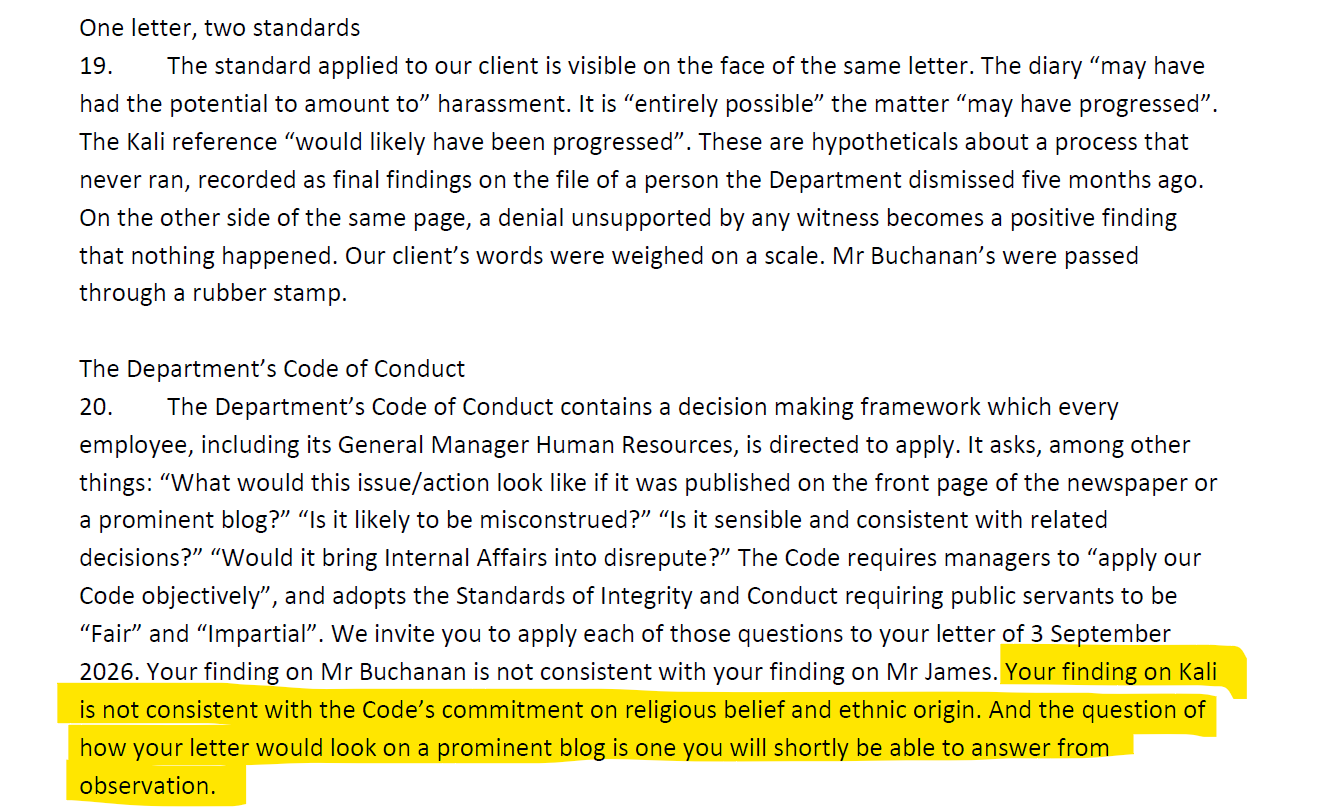
Mr Simon George, if any part of this is unfair to you, you know where to find me, and you know I will publish your answer exactly as I have published everything else.
Do you think any of this will make a difference, or will the Department still record these as findings against me on my file? I don’t think so. Do you think Simon George, Richard Ashworth, Andy James, or Fraser Buchanan would apologise or face any consequences for their actions that have caused me harm? Probably not. But did I do the right thing in speaking up and would I do it again? For that, my answer will always be a YES!
I would like to believe that the Employment Relations Authority will look at all of this, properly, on evidence during the substantive hearing.
I also trust that thousands of you who come back to read my story every single time I post will appreciate that it may not be easy to do the right thing, but doing the right thing is the only way to ensure that the bullies and enablers cannot get away with it forever. If enough of us spoke up, things could change.
Malala Yousafzai once said that one child, one teacher, one book and one pen can change the world. Audre Lorde said something that belongs right beside it, that your silence will not protect you. I believe both of them completely, and writing this series is me picking up my own pen and refusing to be silent about any of it.
