Where Do Our Tax Dollars Go: A Case Study (Part 4) - "We Used to Do This on Purpose." The Unmanageables, Part II
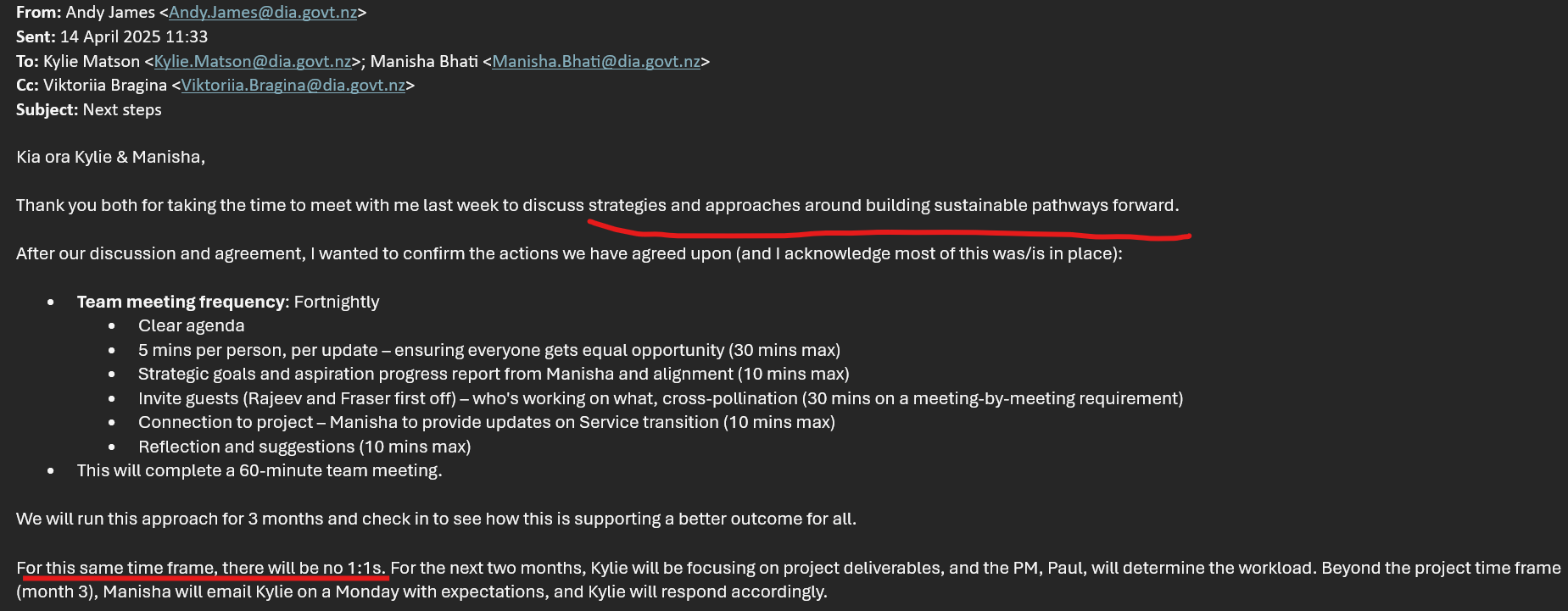
The “communication plan” that forbade me to communicate verbally with my direct report.
This matter is currently before the Employment Relations Authority as a Personal Grievance. Everything I am sharing is drawn from documented evidence. ERA proceedings are, in time, a matter of public record.
In Part 3 of this series, I wrote about Simon Dannefaerd. I described his conduct in detail: the intimidation, the territorial claims over a government platform, the formal complaint filed against me on the exact day I was placed on special leave.
What I did not address in that piece is how one person sustains that kind of behaviour for months inside a government agency without consequence. He did not do it alone.
Workplace mobbing is a specific and documented phenomenon, distinct from individual bullying. It describes a coordinated pattern of behaviour by more than one person, directed at a single target, with the effect of isolating, undermining, and ultimately removing that person from the workplace. It does not require a formal agreement between participants. It requires alignment, a shared objective, and an institution willing to look the other way.
Kylie Matson was one of those people in the back-office team at the Department of Internal Affairs. Not to say there weren't others. But that's a story for another day.
Her role in how DIA treated me and dismissed me, in some respects, was more damaging than Simon's. Simon was visible. He yelled. He made claims that could be examined and tested. Kylie's version was quieter, more institutional, and considerably harder to counter. She worked the system from the first week.
Let me clarify something here. I did not give them the title "The Unmanageables." Someone inside the Department of Internal Affairs used the phrase to describe these two members of my team, Simon Dannefaerd and Kylie Matson. Offered to me as settled common knowledge, as though I should already have heard it. A name that had circulated long enough to become shorthand.
This article explains how it was earned.
I had been Kylie Matson's manager for seven weeks. I sat down with her for a scheduled one-on-one and asked whether she had any concerns working with me.
She said: "I'm just observing what kind of manager you are. I haven't made any determination yet."
Kylie Matson had never managed a team in her professional life. She had no management experience, no background in assessing leadership, and no professional basis for evaluating what good management looked like from a manager's chair. She was a platform administrator. Her job was ARIS access management.
Someone, before I arrived, had given her the framework to sit in judgment of her manager from day one. It became clear to me with time why this was done, and who this benefited.
Kylie came to DIA in February 2022 because Simon Dannefaerd recommended her. They had worked together at Inland Revenue. When he moved to DIA and the ARIS platform needed an administrator, he called her. She negotiated to come across on secondment rather than a fixed-term contract, keeping her IRD job security while she settled in.
She arrived knowing the system because the person who had just taken it over at DIA had called her before the role was advertised.
Simon and Kylie, at the DIA office, in conversation, shared something they used to do at Inland Revenue. They would change the colours in the ARIS interface. Deliberately. Repeatedly. To frustrate their manager. They were recounting this as a fond shared memory, years after the fact.
ARIS is a government platform used across forty public agencies. Changing its configuration without authorisation disrupts a system that public servants across the country work on, and those who have worked on the systems would understand why this is not standard practice. Hint: think of disabled people. These two people had done it on purpose, found it satisfying, and were still telling the story.
From my second week, a colleague who sat near Simon and Kylie noticed that neither of them responded to her morning greetings. She tried again each day. Then she watched Simon greet other staff in the same space warmly and without hesitation. The silence toward her had been deliberate from day one.
Andy James observed the same pattern. When he greeted the team in the mornings, Simon and Kylie did not respond while other members did. He told me he had raised it with both of them. Other colleagues in nearby spaces asked me why the team was not sitting together.
Andy James gave me his explanation for Kylie's behaviour directly. She dislikes you because Simon dislikes you. The Director. About my direct report.
In my private reflections written at the time, I noted that Kylie's behaviour tracked Simon's moods precisely. When he was hostile, she became cold. When he withdrew, she withdrew. When he communicated, she communicated. I wrote that if Simon were ever to leave, I was not sure Kylie could function independently. That is a striking thing to write about a Technical Specialist drawing public funds. I wrote it because I could see it clearly and because I considered it a genuine delivery risk.
Over roughly four years at DIA, first on secondment and then as a permanent employee from October 2024, Kylie Matson was paid between $70,000 and $120,000 per year from public funds. She received a higher salary band when she was made permanent than her previous one as a secondee.
Her core function throughout was managing access to the ARIS platform. When someone at one of the forty dependent agencies needed a login, Kylie processed the request and created their credentials. Manually. One request at a time.
Single Sign-On integration through Microsoft Entra (formerly Active Directory) would have automated this entirely. SSO is standard practice in any modern IT environment. Connect the platform to the organisation's directory and access management runs itself. The manual process Kylie was running was redundant in any properly configured system.
SSO was eventually implemented. It took more than three years.
During the April 2025 ARIS health check, Kylie confirmed in writing that she managed one database. One database. In a system serving forty government agencies. Funded by New Zealand taxpayers. I reported this to Andy James and I was so shocked at this admission that I remember my email to him was: "Do I even need to say anything here?"
One of the formal allegations in Kylie's complaint was that I had never made her role clear. That she did not know what was expected of her. That her manager had failed to sit down with her and explain her responsibilities.
Kylie Matson accepted a job with a written job description. She had held the predecessor role for two and a half years before her permanent appointment. In her first week as a permanent employee, she independently wrote a Standard Operating Procedure for the shared mailbox. She described her own responsibilities clearly when asked: ARIS access support, onboarding, mailbox triage, navigation guidance, technical support.
She is a professional with years of experience in this specific role. She accepted a position. She signed a contract. She had a job description. The idea that her manager needed to sit down with her and explain that job description to her is not a management failure. It is not a reasonable expectation of any professional hire, let alone one who had been performing the role for years before I arrived.
Kylie later gave the reason for the role clarity gap as Andy James not having established clear enough team structures when he came into the Director role. She described Andy as having been too focused on external agency relationships to nail down internal roles and expectations adequately.
She expected me to explain a role she had been doing for years. She attributed the structural gap to Andy James. This person is now the Lead Process Analyst at DIA. She was offered a salary exceeding what she had even asked for.
In March 2025, I reassigned Kylie from a CRM project to allow a process modeller to take it on. Kylie herself had noted there was not much for her to do on it at that stage. This was a standard management decision within my authority.
She went to HR before she raised it with me.
When her email arrived, Andy James was copied. Kylie later gave the reason as wanting him to be fully aware of how I was treating my staff.
Nine days later I received a formal email. Subject: Request for Improved Communication and Clarity in Future 1-on-1 Meetings. HR had been consulted before it was written. Andy James was copied when it arrived. The substance was that she had felt uncertain about a project change and wished she had been told before the team was.
That concern required HR consultation, a formal email, and simultaneous escalation to the Director. If you are wondering why wouldn't she just approach her manager and clarify? Good question, I also asked but never got any satisfactory response.
Every concern Kylie raised went to HR before it came to me. Every written communication arrived with Andy James already in copy. The institutional record was built before I had an opportunity to respond. This was established in February 2025 and held until 18 June.
A meeting was arranged with Kylie, Andy James, and me. During it, Kylie became extremely distressed. She called me a liar, in front of Andy James, in a meeting scheduled to discuss her behaviour with her manager.
I stepped out and gave her space to speak to Andy James privately.
Andy James confirmed on the record that my conduct throughout that meeting was measured and reasonable.
Around this time, one of the other managers said to me directly that Kylie was an "odd nut." I told him he should not be talking about a colleague that way. I said there may be reasons for how she presents, perhaps she is on the spectrum, perhaps there is something else going on, and it was not appropriate to describe her like that.
That same manager later appeared as a witness in the formal investigation into Kylie's complaint against me and stated that my management demonstrated a lack of people management skill.
The institution's response to this pattern was to formalise it. HR and Andy James introduced what they called a communication plan. Under this plan, I was directed not to have direct conversations with my own direct report. Everything had to be in writing. Every task. Every update. Every piece of information that any normal working relationship would handle in a two-minute conversation.
I objected. Andy James asked me to try it anyway.
I wrote to Andy James and HR asking specific questions. How would the effectiveness of this plan be measured? What criteria would determine whether communication had improved? What would happen when the plan expired on 30th June? How would fairness in the performance review process be assured when the manager was prohibited from normal management conversations?
None of those questions received a response.
Over the months this plan was in place, I wrote dozens of emails to a direct report who was sitting in the same office, often just two desks away from me. New Zealand taxpayers funded every hour of that exercise. The plan existed because Kylie Matson had refused to have direct conversations with her manager. The institution's response was to formalise that refusal and require the manager to accommodate it.
One of Kylie’s formal allegations was that I had pressured her into pursuing a leadership role she did not want. She described being encouraged to apply for the Senior Technical Specialist position as pushy and almost aggressive. She said she had no aspirations for leadership and never had.
Kylie later gave the reason for her earlier unsuccessful application for the Senior Technical Specialist role as not having had the leadership qualities they were looking for.
She had applied. She had been assessed. She had not been appointed.
In April 2025, I scheduled an ARIS health check. A standard governance activity covering the current state of the platform and training needs across the forty agencies using it. Kylie was a required attendee. The agenda and questionnaire were sent in advance.
One hour before the meeting, she cancelled. Her reason: project work due the following day, an activity which would be planned as per my experience in projects, especially if a project was running on a tight schedule, as noted by the project manager and everyone involved.
I replied that opting out without prior approval was unacceptable and asked for a written breakdown of her current tasks. She went to HR. She said she had been shaking when she read my email, because she thought I would fire her for this. HR told me pursuing the task breakdown would escalate the situation. They advised me to follow the terms set out in the “communication plan”. Yes, the same one which forbade me to directly communicate with Kylie Matson.
The health check proceeded without the Technical Specialist whose job was to administer the platform being assessed.
Kylie was once asked about an email she had written regarding ARIS admin access controls. An official technical document about who should hold administrative rights over a government platform serving forty agencies.
Had she written it herself?
She said she had used "a little bit of help from Simon and a little bit of help from ChatGPT to get the language right." Simon had read it before it went out.
The person managing one database, drawing public funds, too distressed to attend a governance meeting about her own platform, whose official technical communications were written with AI assistance and reviewed by the colleague with the strongest interest in controlling system access. You can draw your own inference from this.
Another remarkable incident comes to my mind, something I have never experienced in my career. Three of my team members and I were in a meeting room during one day. A team member's pen stopped working. He opened the door to get a replacement.
Kylie almost fell into the room.
She had been positioned directly outside the closed door. Three people witnessed this. A Technical Specialist drawing between $70,000 and $120,000 per year in public funds, standing silently outside a closed meeting room door.
In June 2025, I completed the annual performance reviews. Andy James had instructed that all staff in the newly formed team, in roles for under a year and without formally established KPIs, would be rated "new to role, developing." I applied this to every team member consistently.
Kylie received that rating and disputed it in writing. She cited three years of history and included endorsements from colleagues who had known her since before I arrived. I asked for documented deliverables assessed against her job description for the current review cycle.
In her own written submission, Kylie described herself as "new to this title."
Before I get to how people outside work reacted to Kylie's complaint, here is what the complaint actually said.
It alleged I had breached her privacy by asking about her medical condition. It alleged I had pressured her into a leadership role. It alleged I had excluded her by cancelling a team meeting and then holding a separate session with other team members. It alleged I had removed her from a project without discussion. It alleged my tone in specific emails and a Teams message had been inappropriate. It alleged I had appointed a Lead without following a proper expression of interest process (a role she was not interested in). It alleged her performance rating as assessed by her manager was unjust because she said so. It alleged I had removed her SharePoint access without explanation ON the day the department was putting me on this 'special leave'.
It also alleged that I had sent an appreciation email to Andy James, the Director, recognising Kylie's contribution, and copied Kylie in.
A manager recognised her report's work in writing to senior leadership and included the report so she could see the recognition. That is not a management failure. That is called doing your job well. It appeared in the formal complaint as evidence of misconduct.
The complaint also alleged that my general politeness toward Kylie was evidence of something suspicious. She described it as me trying to buddy up with her. In her reading, a manager being professionally courteous was not courtesy. It was a strategy.
And it alleged, based on a single remark I had made in our very first one-on-one about inclusive leadership and my experience working internationally and my statement ‘I support women because it is harder for them to succeed in predominantly male environments’, that I hated men.
In my opinion, the complaint summarises to this: my manager gave me work, reassigned work, recognised my contribution publicly, asked after my health, was polite to me, and was interested in my career growth.
I shared it with my family and friends, people with management experience who know what a genuine grievance looks like. At first they laughed and said: "Well, HR would never accept this as a complaint. Don't you have policies for handling false and malicious complaints?" When I told them the complaint had already been accepted and would be formally investigated, they were shocked. Because it made zero sense.
On 18 June 2025, I was placed on special leave. That same day, Kylie and Simon both lodged formal complaints with the Department, through the same PSA organiser, simultaneously.
I had been raising concerns about both of them since January. Five months in an informal HR pathway. No formal investigation initiated on anything I raised against Kylie. Their complaints were actioned the same day they were filed. An external investigator was engaged within days. Most notable thing in this is that DIA still insists that I "forced" them to hire an external investigator while they wanted to resolve these complaints through internal processes. The same internal processes that denied my right to file a complaint, treated a brown manager differently than a white team member, and drove a single mother of three children to serious harm.
Some months later, while the investigation into Kylie's complaint was still ongoing, Kylie applied for and was appointed to the Lead Process Analyst role. The role requires sustained external engagement with government agencies, collaborative leadership, and continuous people-facing work across organisational boundaries.
Kylie's complaint had rested on the claim that she was an introvert, that people-facing situations caused her anxiety, and that encouragement toward leadership had been harmful to her.
She applied for a role requiring all of those things. And she was appointed. The final decision on this appointment came from the manager who had called her "an odd nut" and another manager who was acting in the role in my absence. The conflict of interest in that appointment process is documented. The acting manager who made the final hiring decision also provided a reference for Kylie for the same role. A hiring manager providing a reference for her own candidate, in a process she controlled, while an investigation into that candidate's complaint was still ongoing.
We will talk about this acting manager in a future article, a person who kept claiming to be "the new girl" for about seven months.
Kylie later gave the reason for her comfort with the new role as the manager at that point being someone she found easy to work with. The same new manager who many colleagues reported as struggling with setting up a basic ticketing system.
A person who spent months claiming her manager had failed to understand and support her technical work was most comfortable the moment she had a manager who allegedly lacked the technical knowledge to assess that work.
I was still listed as Kylie's manager in the HR system when her offer letter was prepared. I received the system notification that the offer was ready to send. The offer made to her exceeded what she had requested by NZ$10,000. At the time when the organisation was downsizing to save money. Maybe the department will explain this in the future.
Kylie Matson is still employed, now at Public Service Commission (PSC). In a senior role. Better paid than she had even asked to be.
