Where Do Our Tax Dollars Go: A Case Study (Part 2) - The Manager Who “Had my back”
Note: This matter is currently before the Employment Relations Authority as a Personal Grievance. This is my lived experience, and I am living it now.
There is a particular kind of person who shows up in the hardest week of a new job and presents themselves as someone who could be a friend. Not just a manager. Someone who gets it, who sees the room clearly, who makes you feel like you have an ally in a place that is still unfamiliar.
The Director of the team I was going to join, Andy James, was my line manager. Before I had even started, he reached out. He told me the team had some difficult people. He did not name names. But he assured me he had my back.
I started on the 13th of January 2025. Within two weeks, I had met the difficult people he was referring to.
And it was so strange to me. I was constantly being harassed by the person who directly reported to me, who was claiming 'she stole my job'. Rather than doing the work I had assigned him, he seemed determined to make my position in the team as difficult as he possibly could, working to undermine my authority at every opportunity and making it clear to everyone around us that he did not accept my leadership. From that moment, things were progressively getting worse.
And into all of that came someone who said: I see what is happening, and I am on your side.
I want to be clear about something. I am not saying I saw Andy as anything other than my manager. What I am saying is that in a hostile environment, someone in a position of authority over you offering consistent support carries weight. For a woman of colour in a senior technology role, in a place that was already signalling I did not quite belong, that kind of support from a Director is not nothing. It is oxygen. And it shapes what you feel you can and cannot say in return.
Which brings me to the language.
When the messages started becoming inappropriate, I was uncomfortable. I want to be honest about that. But Andy was my Director, not my subordinate. I could not correct him the way I could have corrected someone who reported to me. The power imbalance made that effectively impossible. In the moment, I let things pass. It was only later, in a conversation with a friend, that I named what I had been absorbing and recognised it for what it actually was - highly unprofessional conduct by someone in a senior position of authority.
I want to show you what that language looked like. Because I have the screenshots, and I think you should see them.
In March, Andy messaged me from the middle of a meeting he was in. He was with a woman, a professional, someone he was there to engage with on behalf of the department.
"She's a tit."
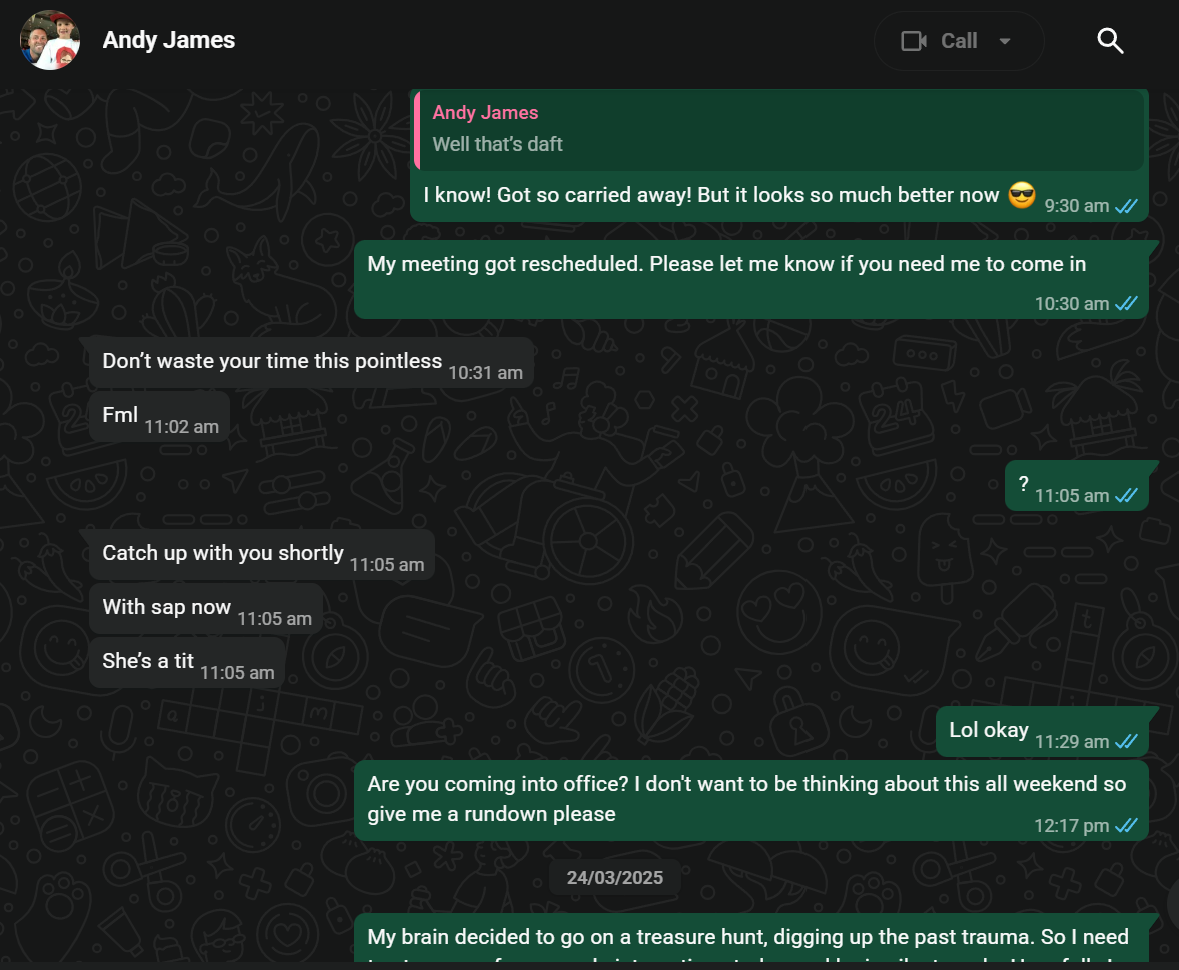
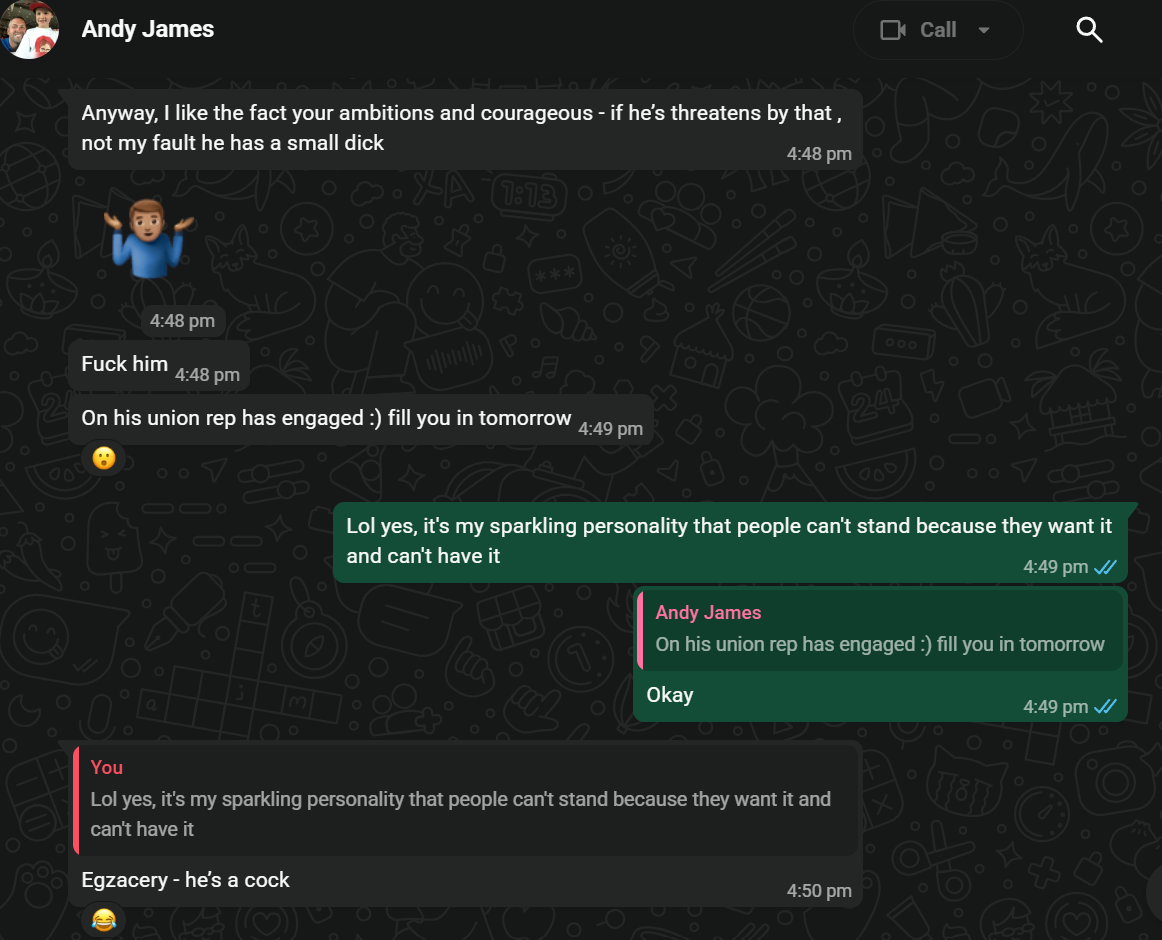
A few weeks later, we were messaging about Simon. The person I had formally raised concerns about. The person whose behaviour I had documented and escalated and watched go unaddressed for months while I continued to be held accountable for delivery. I told Andy that Simon seemed to have raised the race issue specifically to neutralise my ability to name what was happening.
Andy's response:
"Anyway, I like the fact your ambitions and courageous — if he's threatened by that, not my fault he has a small dick."
"Fuck him."
"Egzacery — he's a cock."
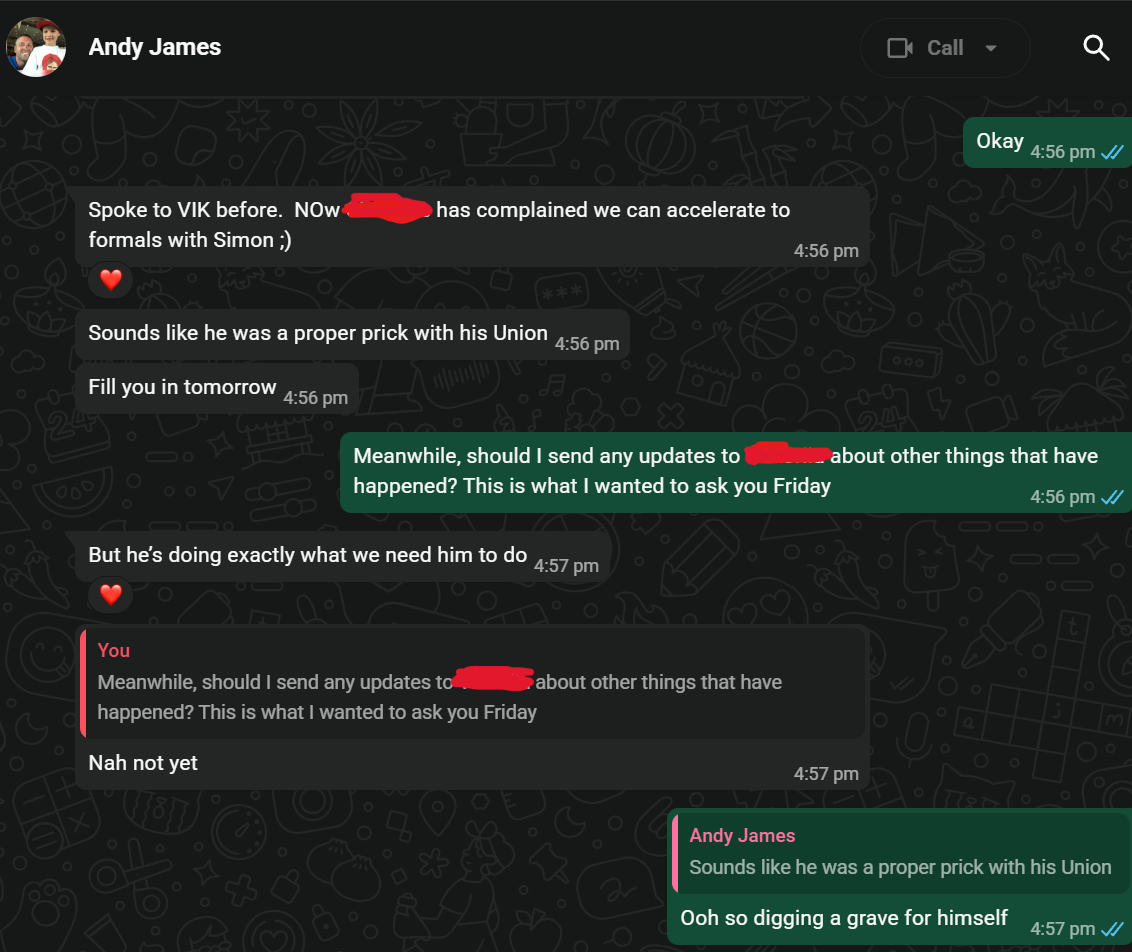
A few days after that, Andy began updating me on the informal HR process around Simon. Not in a meeting. Not in a formal briefing. In WhatsApp messages, on his personal phone, after hours. He told me that now another team member had made a formal complaint, they could accelerate things. He added, about Simon's behaviour with his union representative: "Sounds like he was a proper prick with his Union."
I want to pause here, because this is the part that matters beyond the language.
These were informal HR processes. At the time, I assumed it must be appropriate for a Director to discuss them this way. He was the one initiating it. He was in the senior position. I had no reason to believe someone at that level would be handling things in a way that fell outside acceptable boundaries. I understand now that that assumption was wrong. But the assumption itself tells you something about how the power dynamic was operating.
By May, nothing on the floor had changed. The behaviour I had raised concerns about had not stopped. The processes were moving in the way that processes move when institutions are more interested in managing situations than resolving them. I had started seeing a therapist. I was having migraines, losing weight without trying. One night my blood pressure hit numbers that frightened me.
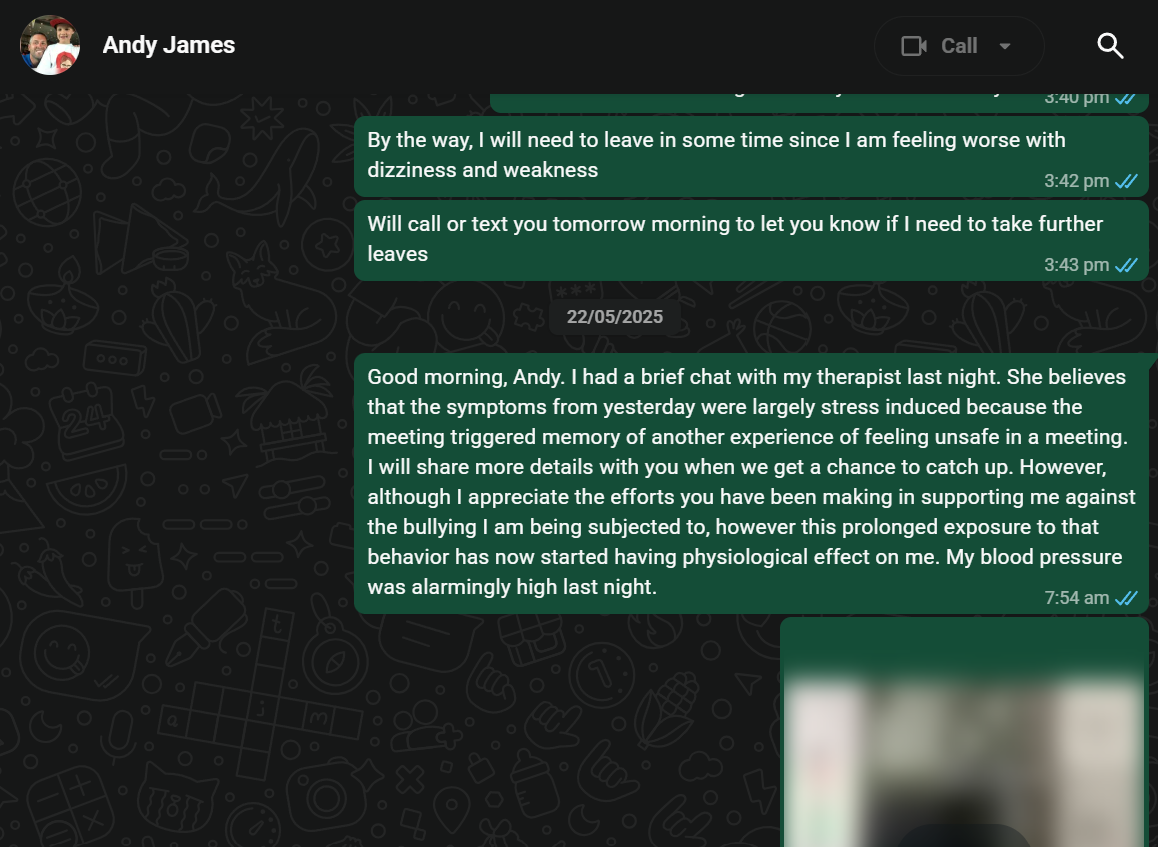
I sent Andy the photographs with this message.
I sent them because he was my manager and this was the evidence of what was happening to my body.
Then came the letter from the department which completely derailed my career path.
What I did not know until later was that Andy had been sitting on a private diary note I had shared with him in confidence for six weeks. During those six weeks, he continued to message me, continued to offer support, and gave no indication whatsoever that anything I had shared with him had made him uncomfortable.
And then, he placed the diary note in front of HR at precisely the point I refused to accept that what I was experiencing was simply a personality clash rather than bullying. The timing of that decision is something I will leave readers to consider.
The letter I received from Richard Ashworth, General Manager, was handed to me in a meeting titled ‘HR issues catch-up’. Instead of any of my complaints to HR, the concerns raised were about that private diary note and what the department described as the emotional intensity of some messages I had sent to Andy. The shocking part is not only that I was ambushed by mislabelling the meeting, but also, I was forced to choose between starting a ‘special paid leave’ in that moment or attend a potential ‘suspension meeting’ the next Monday.
Let me say it again - the letter was not about the above messages by Andy, or about my complaint to HR. But it was about what I shared with my manager who seemed to be an ally at the time.
A Director calls a woman in a meeting "a tit." He tells his female direct report that a male subordinate has a "small dick" and is "a cock." He shares informal HR process updates about named employees via personal WhatsApp messages. None of that generates a letter. None of that triggers a fact-finding meeting or investigation. None of that, apparently, raises concern for the Department.
But a woman writes privately about how she is feeling, shares it in confidence with the person she trusts, and that becomes the conduct issue.
Richard Ashworth (now at the Public Service Commission), I have two questions for you, and I am asking them here because I want them answered in public.
Do you think this is how a Director at the Department of Internal Affairs should communicate with a female member of his staff?
And why did you not consider any of it worth investigating?
I have the full conversation. Every message, every timestamp, all of it shared with DIA. Andy James remains a Director. The colleagues I raised concerns about remain on the team. Richard Ashworth remains their General Manager. And I, a brown woman who raised concerns about sexual harassment by her manager and the conduct of a colleague, have been dismissed for what the department describes as an ‘unrelated matter’. Draw your own conclusions.
That is where this story currently stands. I will keep updating this series as things develop, in real time, as they happen.
Follow this series to understand what happened, how it happened, and why I am still here talking about it.
