Where Do Our Tax Dollars Go: A Case Study (Part 9) – My Private Note. Their Weapon.
The views in this post are my own, based on my lived experience and personal recollection. My ERA proceedings against the Department of Internal Affairs are ongoing. All existing supporting documents and evidence will be disclosed through that process.
I have been working in technology since 2003. Across countries, organisations, industries. Through good managers and terrible ones. In over two decades I have seen a lot of dysfunctions.
Yet, nothing prepared me for what happened with my private note.
I have thought about it every single day for eleven months. How something that was never sent to anyone, never emailed, never messaged, handed over in a private moment of trust to someone I considered a friend, became the instrument of my removal from a government job. I still cannot make any sense of it. So let me try to explain it to you from the beginning.
There is a tool in Microsoft 365 called OneNote.
It is not an email. It is not a text message. It is not addressed to anyone, and it goes nowhere. It is a note. A private digital space where you write to yourself. Where you process a difficult day, vent about a frustrating week, say the things you cannot say out loud. I write the way I think. Personally, directly, sometimes with lots of emotions and questions. Anyone who has read this series will know that. It is simply who I am.
That note became the reason I was removed from my job at the Department of Internal Affairs.
But before I tell you what happened to it, I need to tell you about the relationship that made me feel safe enough to write it in the first place.
I have talked about my manager Andy James in Part 2 of the series. Read it here - https://www.voicesworknz.org/blog/andy-james-richard-ashworth-dia-whatsapp-messages. As I have said before, from the very beginning of my time at DIA, he said something he would keep saying. He said he had my back.
What followed felt, for a long time, like something genuinely good. He was warm. He was funny. He was what I can only describe as goofy. He made the workplace feel human. We talked the way people do when they feel comfortable with each other, the way I do with my other friends. He told me Jimmy Carr was his favourite comedian. I told him mine was Trevor Noah. We talked about differences between workings in private sector and public sector. These are small things. But small things are how trust is built. You talk about comedy and then you talk about your ambitions and then, before you realise it, you start trusting the person at the end of that conversation.
He shared things with me that most managers do not share with their direct reports. He told me when he had a medical scan coming up, and when it was delayed, and why. When he got the all-clear, he told me before he had even called his wife. He said he should call her and I said of course, she would be so relieved. Then he showed me the message he had sent her. He also showed me a video of a surfboard he had bought her as a gift. They had a running competition trying to outdo each other with presents, he said. I found that charming. I thought it was the kind of thing you share with a friend.
I know the name of his dog. I have a photograph of his dog, taken during a meeting. That is the kind of relationship this was.
When he told me he and his wife were going through a difficult time, I found a book I thought might help and sent it to him on an official email telling him this was for her. That is in the official record. That is what you do for someone you care about or think of as your friend. It is not what you do for someone you have feelings for in any other sense.
Andy James also went back and forth between me and HR on my behalf. Or so I believed. I had been raising concerns about bullying within my team since February 2025. Every time I pushed for something to happen, Andy James would return from conversations with HR carrying explanations for why things could not move faster. Perhaps it was how public sector worked versus the private sector. Perhaps the informal process was simply the only available pathway. He kept positioning himself as someone navigating a system on my behalf, and I kept trusting that, because everything he showed me said I could.
My lawyer said it clearly in formal proceedings. I was following his lead. He was the Director. He set every register of how we operated together and I matched it.
He also made jokes. Off-colour jokes. Jokes that crossed lines. I want to tell you about one that happened before the joke that sits at the heart of this post, because it tells you something important about who I am.
A colleague was showing photographs of her teenage daughter to people in the team. People were saying kind things as we all do – she’s so pretty, she looks just like you, what a beautiful pic. When she showed the photo to Andy James, he said he did not recognise her with her clothes on. About a teenage girl, the daughter of someone who is at two levels below him, in front of the mother.
I told him directly that was not acceptable and that family was off limits.
I mention this incident because I want you to understand something about me. When I see something wrong, I address it. Directly. Respectfully. In the moment or at the next available opportunity. Not through formal complaints as a first step, but through direct, adult conversation as these things are supposed to be handled in a workplace with other adults.
People cross boundaries sometimes. We all have different values, different cultures, different ideas about what is appropriate. That does not automatically make someone a bad person. What matters is what happens when you tell them. So that is always my first step. Tell the person clearly that they have crossed a line and give them the chance to do better. You cannot run to HR every time someone says something that lands badly. But you do have to speak up. Politely, directly, and without apology. My response to another sexually explicit joke by Andy was completely consistent with that.
It was the end of a working day. Andy, Fraser, and I were doing an informal catch-up, the kind where you go over what had happened and check in before heading home. Andy mentioned the possibility of attending an ARIS conference offshore. He suggested I take Simon. Simon Dannefaerd was my direct report, and I have talked about him in this article (https://www.voicesworknz.org/blog/simon-dannefaerd-dia-technical-specialist-conduct). What Andy said next is formally documented as an allegation in DIA's own fact-finding records. He said to imagine Simon was inside me and having a seizure while he was inside me. He acted it out. I kept asking him to stop. He did not stop despite my repeated requests. I want to be clear about this because it may sound like a moment that ended quickly. It did not. He finished the joke before he stopped. A joke acted out with gestures, with laughter, while ignoring how it was impacting me. I was not laughing; I was not smiling. I was horrified.
The next time we had our regular one-on-one meeting, I told him directly that he was never to make a sexual joke about me with anyone. That was my boundary and I wanted it to be clear. He said he understood. He also said that one thing about me was that I had clear black and white ethics, while he thrived in the grey.
I have thought about that line many times since.
At his own fact-finding meeting, Andy told Richard Ashworth that he would not have made this comment because the conference was never finalised and we never actually went. Richard Ashworth accepted that as a reasonable explanation.
I want you to hold that thought. Because in my termination letter, Richard Ashworth refused to accept any explanation I gave for anything. Not one.
Soon after the one-on-one conversation, Andy James went on leave. When he came back, he refused to speak to me. I am not saying he spoke to me less or was more formal. He just refused to speak to me at all.
Not about work. Not about the urgent matters I was seeking his support for. Not about the formal complaints I had been raising for months. The person who had texted me all the time, who had shared scan results and surfboard videos and his dog's name, came back from leave and went completely silent. Emails went through as usual, although the responses to my requests to talk, meet or address any issues were mostly ignored or dismissed. In person, silence.
I want you to understand what that silence felt like. I had come from a professional culture where silence from a senior colleague means you have done something wrong and it is your responsibility to repair it. This was my first experience in the New Zealand public sector. I was managing a difficult team largely alone, documenting everything, following every process available to me. The person who had built the conditions for me to feel supported had simply stopped acknowledging my existence.
So, after those days of silence had stretched on with no response to anything I tried, I did something I have thought about every day since.
I printed pages from my OneNote and gave them to Andy in person. Not as a formal document. Not as a complaint. The note itself explained why I was handing it over as a printed copy rather than emailing it. I wrote that I was choosing the paper route so it would not become part of any audits, and that the gossip in it was not supposed to be anyone's concern. I gave it to him as a printed copy, by hand, as a reach toward someone I still believed was my friend. I thought if he read it, he would understand how isolated I had been and how hard I had been trying, and that he would talk to me again.
He put the pages in his bag. He said nothing. Not that day. Not in the days that followed. Not in the weeks that followed.
On 11 June 2025, I sat in a meeting with Andy and HR where I was told my formal bullying complaints against Simon Dannefaerd would not be investigated. At some point in that meeting, I said plainly that Paul James had been encouraging everyone to speak up about bullying and I would be happy to go to him directly.
Around that time, Andy James suddenly discovered the pages he had placed in his bag weeks earlier without, he claimed, having read them. Think about that for a moment. I had handed him those pages in the first week of May. He claims he did not read them. He claims he forgot they were there. He claims he found them, weeks later, while cleaning out his bag. And he claims all of this happened to coincide with the day I said I would go to the Chief Executive.
On 16 June 2025, I emailed Paul James directly.
On 18 June 2025, I was called into a meeting. The calendar invite said HR issues catch-up. There was no agenda attached. I logged in expecting to finally discuss what had been happening with Simon Dannefaerd's misconduct, which I had been raising and documenting for five months. I had no support person. I had no reason to think I needed one.
As soon as the meeting began, and Richard mentioned something about a private note, I said I was not comfortable proceeding without a support person since the agenda of the meeting was clearly different than I was told. I said very clearly, I did not want to be in that meeting. Viktoriia Bragina told me I had no choice in the matter. I was then presented with two options. Formal suspension, or something called Special Paid Leave. I had minutes to decide. I was unsupported in that meeting, had never heard of this special paid leave, did not know what that meant, or how it was (if at all) different from a suspension. I did know what suspension meant though. So, I chose the option that sounded less like the end of everything.
After this meeting, I had to go and find a lawyer to help me with the process. I had approached the PSA, but they refused to support me.
My lawyer later confirmed in writing to the Department of Internal Affairs that what they did was a de facto suspension. DIA's own Disciplinary Policy requires that an employee be given the opportunity to respond before suspension. The Employment Relations Act requires good faith. Natural justice requires the right to be heard. None of those things happened on 18 June 2025.
I was removed from my workplace, given instructions not to access systems, and prohibited from contacting my team. Simon Dannefaerd, against whom I had filed a formal bullying complaint weeks earlier, continued coming to work every single day.
Now I want to show you something.
These are the kind of questions I was asked in my formal fact-finding meeting on 17 July 2025. This meeting was related to the private note that Andy James shared with HR and management almost 6 weeks after receiving it.
These screenshots are extracts from DIA's own HR meeting notes. They are DIA's record of what was said, not direct quotes, and may be incomplete.
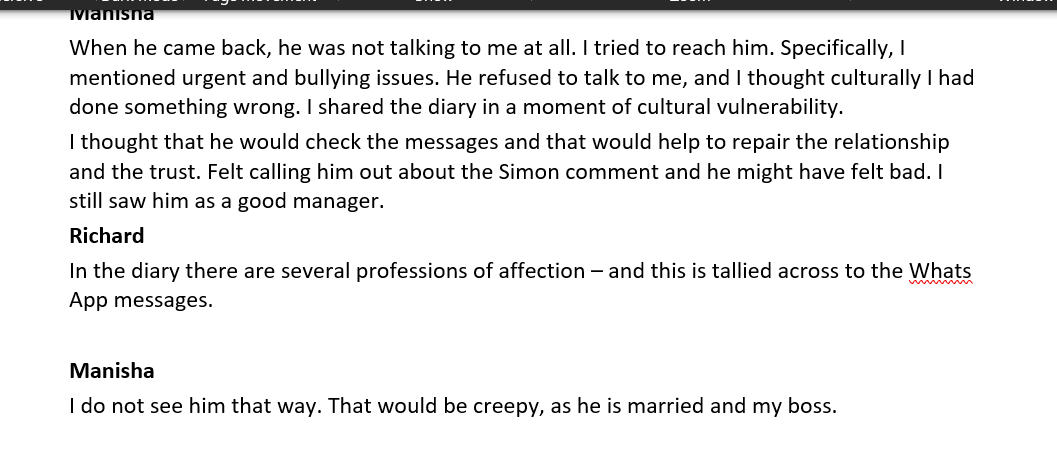
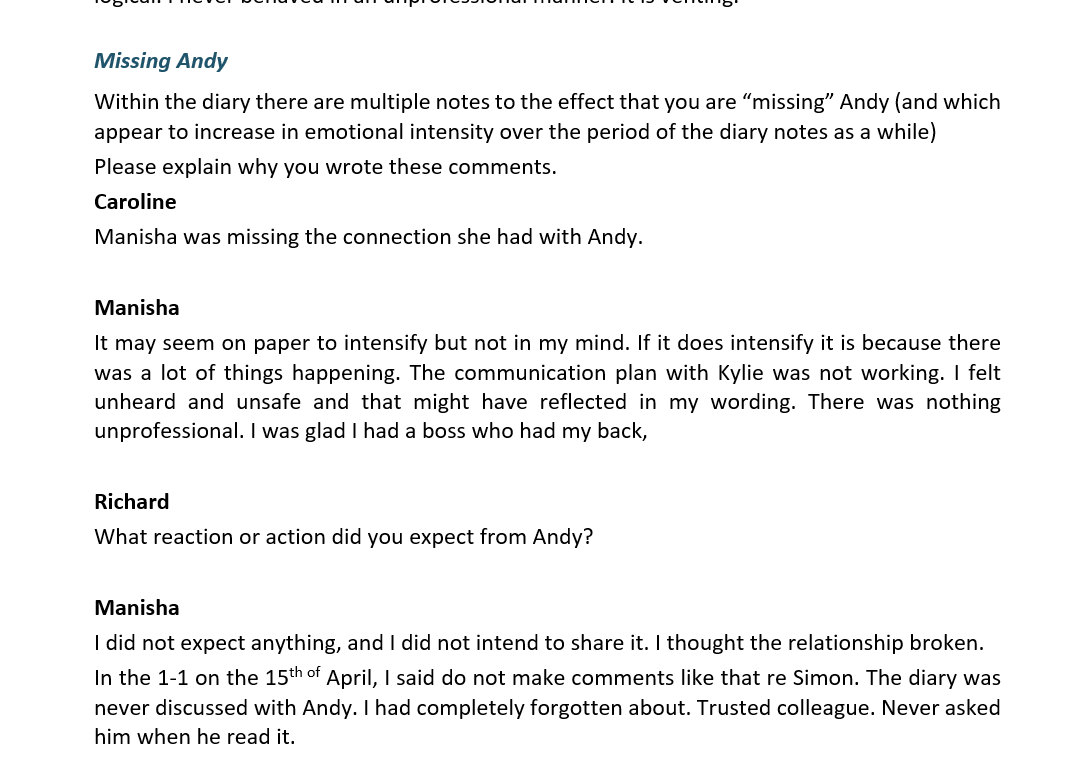
They kept referring the note as ‘diary’ and I think that’s incorrect framing because it was a private note, written in OneNote
Why did you write this ‘diary’? Is writing therapeutic for you? Why did you say you wanted to punch a colleague? Why does the emotional intensity of your entries increase over time? Do you have romantic feelings for your manager?
When they asked me about romantic feelings my response was immediate and genuine. I said that would be creepy. He was my boss and he was married. I did not arrive at that answer after careful thought. It came out because it was simply true.
They also used my own words against me in that meeting. I had described Andy generally as goofy because in many ways he was, and I had said I had not escalated the Simon joke formally because I addressed it with him directly the next day, which is exactly what you are supposed to do. DIA took that and turned it into a suggestion that I was now raising the complaint cynically and without credibility. What I was actually doing was explaining the nature of a relationship that had made me feel safe enough to address things informally.
I shared Andy's messages in that meeting for exactly that reason. As context. To show the relationship we shared. To show why I had trusted him. To help them understand the friendship I believed we had.
That explanation was not treated as context. It was treated as further evidence of the problem they had already decided existed.
These are some of the questions Andy James was asked at his fact-finding meeting on 7 August 2025.
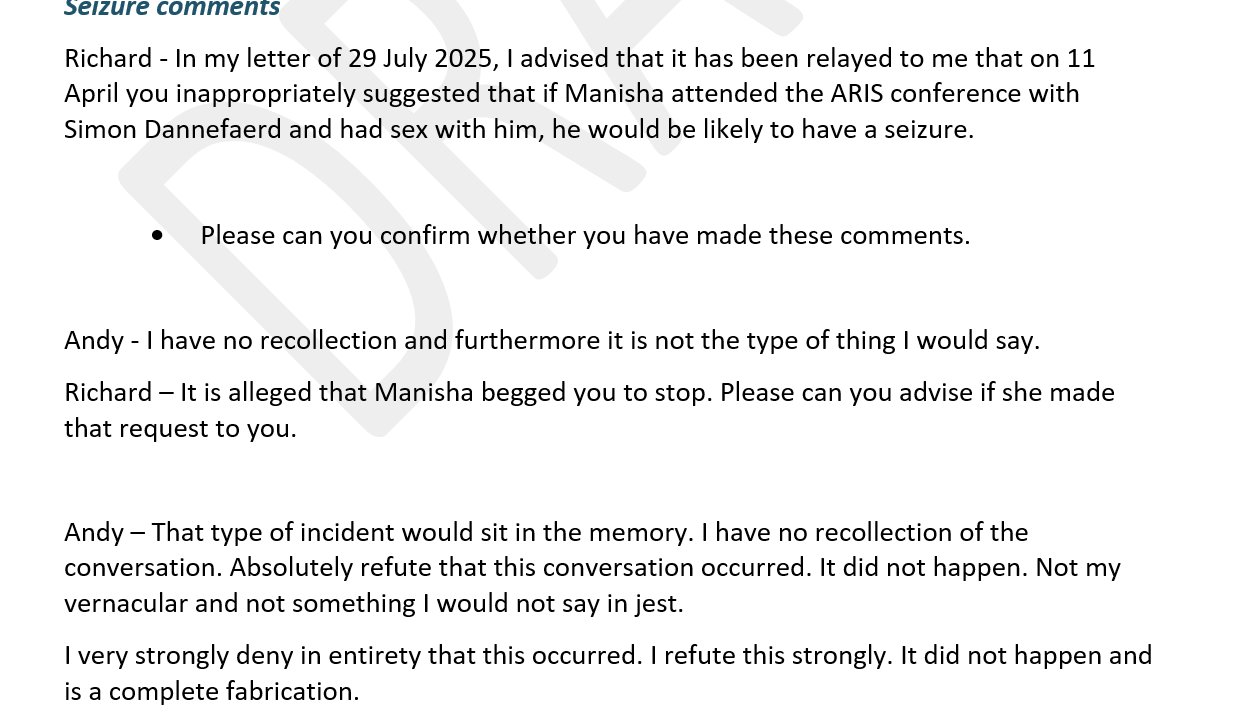
“I have no recollection of the conversation” - is that a reasonable response to such a serious matter?
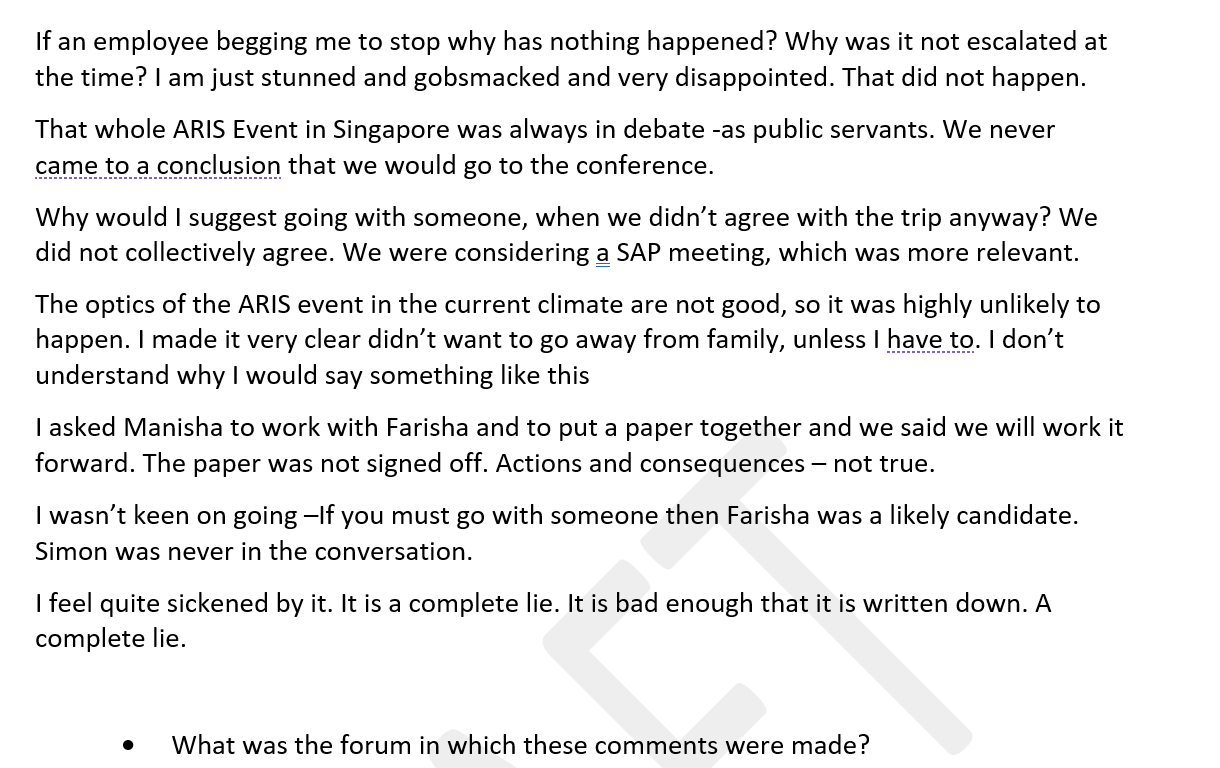
And no follow-up as to “Why would she lie about this?”
He was asked whether he had made the comment about Simon. He said he had no recollection. He said it was not the type of thing he would say. He said it was not his vernacular. He said it was a complete lie, a complete fabrication. He said he was stunned and gobsmacked. He said he felt quite sickened by it.
Not once did Richard Ashworth or Flora McIntyre ask him a question that should be the obvious follow-up to that statement. Why would Manisha make this up? What would anyone have to gain by inventing a comment like that and putting it formally on the record, knowing it would be put to Andy James to respond to? If there was no recollection, and no motive to fabricate, where exactly was the investigation going? That question was never asked. It does not appear in the notes.
He was also asked about the WhatsApp and text messages, which are part of the official record. If you want to read about what those messages contained, Part 2 of this series covers some of them. In his fact-finding meeting he acknowledged he should not have sent them. He said he regretted them. He described them as banter.
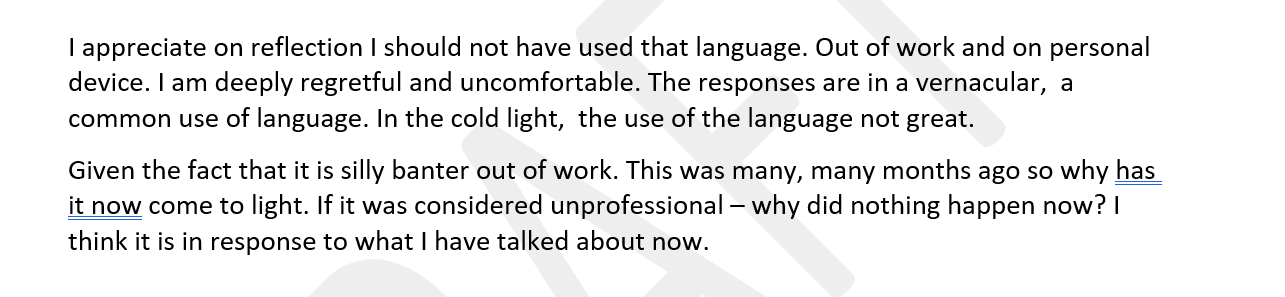
In my fact-finding meeting, I also said I should not have shared my private note with Andy, that it was personal writing never intended for anyone else, containing a sentence at the end that said precisely that. I was sitting in a room with a lawyer, having been removed from my workplace. When he said he should not have sent those messages, it was considered a reasonable explanation to dismiss the concerns. When I gave the same explanation, it was rejected.
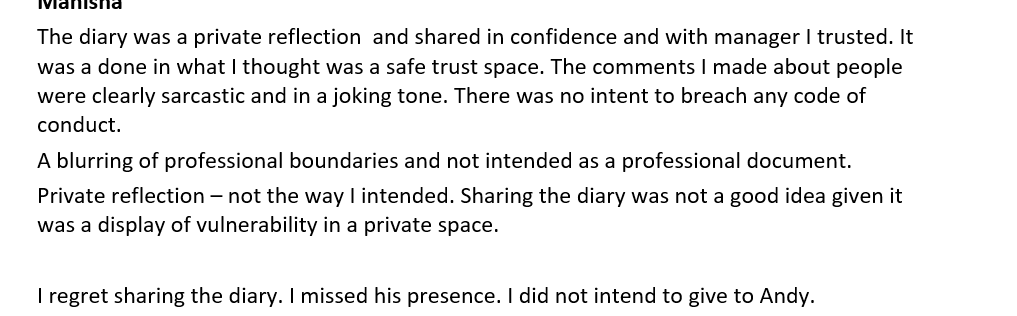
Same sentiment ‘should not have shared it’ yet different outcome for me than for Andy James
Now let me tell you what was actually in that note that DIA cited as evidence I was a physical threat to my colleagues.
I wrote that I had survived a difficult workshop by reminding myself not to punch Manager X.
On the last evening before Andy went on leave, walking to the bus stop after we had both worked late, he said to me: don't kill Manager X while I'm gone. It was a running joke. I laughed. Weeks later, writing to myself in private, I echoed it.
Let me tell you something about Manager X and me. We did not always see things the same way. We had genuinely different approaches, different instincts, sometimes different views even in formal interview processes we were part of together. We both knew it. We acknowledged it openly. We resolved our differences through conversation and mutual respect, and we recognised that where he had authority, that was simply the reality and we worked within it. That is what professional adults do.
He was also the person who, in a meeting chaired by Andy James with Fraser Buchanan also present, watched Farisha Begg raise her voice at me aggressively while I was speaking. Neither Andy nor Fraser said a word. Manager X was the one who stepped in and told her to stop, because I had been expressing my view exactly as anyone else had.
I also want to address the Kali reference because it still takes my breath away.
Kali is one of the most important figures in the Hindu tradition I grew up in. She is the goddess of justice and power. She is fierce because she confronts what is wrong. When I invoke Kali in my private writing, it is the same as a Christian invoking St Michael the Archangel when they feel surrounded by injustice.
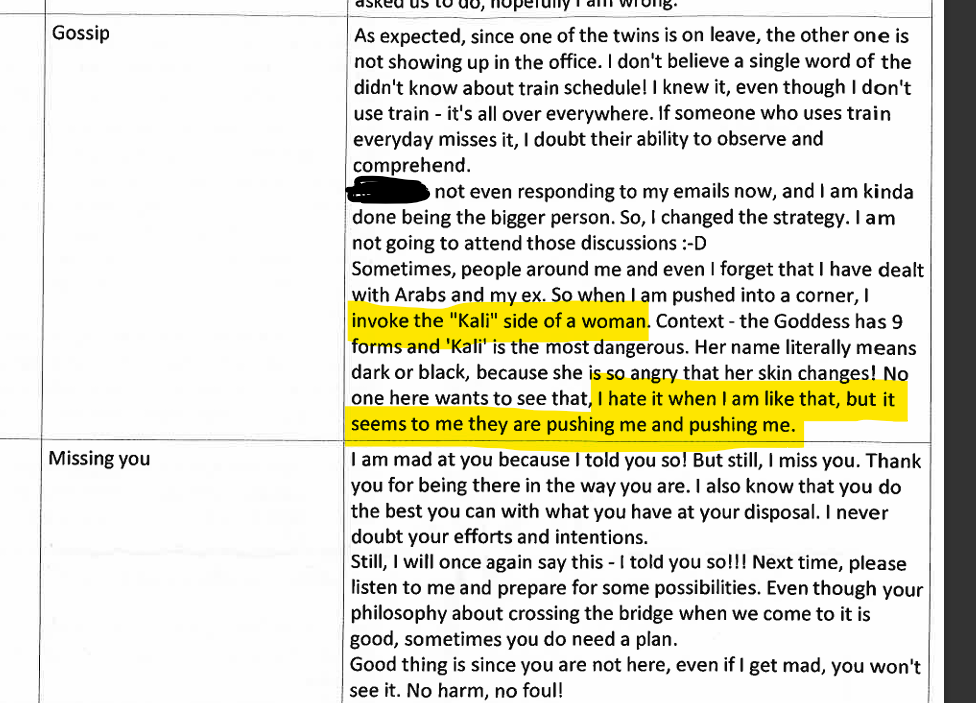
St Michael is depicted with a sword, standing over a defeated demon. Nobody calls that a threat of violence. They understand it as a call for divine justice. That is exactly what invoking Kali is. DIA read it as evidence I posed a risk of physical harm to my colleagues and included it in the letter proposing my suspension.
DIA never interviewed Manager X. Not once throughout this entire process. They never asked him whether he felt threatened by me. They never asked him whether I had ever been violent or aggressive toward him. They cited him by name in a suspension letter as the target of my alleged violent tendencies without asking him a single question.
To be very clear: Manager X never raised any concerns about me. Not once. Not informally. Not formally. Never.
I want to ask the Department of Internal Affairs this question. If the person you named as the target of my alleged violence never came to you with a concern, where did that allegation actually come from? And why did you reach into my private writing, extract a reference to a goddess from a tradition that is not yours, and use it to make that allegation sound credible?
That is not a safety assessment. That is a person's faith being used against them. It would have taken anyone at DIA five seconds and a search engine to find out about Kali. That search was never done. Instead, a goddess worshipped by over a billion people was submitted into a formal employment document as evidence that their employee was dangerous.
Then there is the question of the entries where I said I missed Andy James, the ones that were presented as evidence of romantic feelings. When my friends read that note, they asked me a question. My siblings asked it too. My therapist asked the same question. They all said the same thing in the same words. Is that it? That is what they suspended you for? No one I have shared the note with ever came back and said to me it must mean I had romantic feelings for Andy. No one.
I have been writing since long before I worked in technology. Writing is how I process things. The section about missing Andy was about missing the support of a manager I had trusted. It was professional. It was honest. It was a column of thoughts in a private document that was never supposed to leave my hands.
And I keep asking myself one question about all of it. If Andy genuinely believed I had feelings for him, why did he never say so to me? Every time I had a problem with Andy James, I told him directly. I addressed things openly and respectfully because that is what I believe in. If he had a concern, why did he not do the same? Why was he still telling me about his wife and his children and showing me videos and pictures of his personal life, if he felt uncomfortable around me? Why was he still going back and forth to HR on my behalf and texting me informally? Why, if he had this concern for weeks, did he not say one word to anyone, including HR, about it until the day after I said I would go to the Chief Executive?
I gave written responses to the Department of Internal Affairs, for their suspension letter. I attended a meeting to respond to all their questions. On the other hand, Andy raised this concern by telling someone in HR verbally that he felt uncomfortable. That was it. No written complaint. No documentation. No formal record of any kind. A verbal report to someone in HR, taken at face value, with no verification of any document, no metadata check, no authentication process of any kind. DIA's own policy states that allegations received from another person are usually verified before any disciplinary process begins. Their own Privacy Act response confirmed that no verification was undertaken.
His spoken word removed me from my workplace in days. My formal written complaints, documented and evidenced over months, required me to go to the Chief Executive before anyone took them seriously. And once I did, I was removed from the workplace.
Now let me talk about what this cost.
The so-called investigation into my private note has involved one formal meeting with Andy James in August 2025, two meetings with me in July and November 2025, and one meeting with Fraser Buchanan in March 2026, a meeting that happened even after I had raised serious concerns about Fraser's own conduct. The investigation has never been completed. Eleven months later it remains unresolved.
But those are just the formal meetings. Think about everything else. The preparation, the legal advice, the HR consultations, the back and forth, the letters, the responses to responses. Take one General Manager, one Director, one Senior HR Advisor, one HR Business Consultant, DIA's internal legal team, and me, the manager who was being paid to be on leave instead of doing the job I was hired to do. Across all of those people, across the months this has continued, we are talking conservatively about fifty hours of senior public servant time spent on a private note that was shared in confidence with one person and should never have entered a formal process at all.
My annual salary was in Band K, and the related information is available online. I was on leave for nine months, not doing the work DIA was paying me to do. That is approximately $120,000 of salary paid to someone who was not working, while Lisa Gibson was separately paid to cover my role. The cost does not stop there. There is also the time of every person who has touched this matter in any capacity.
All of it, every dollar of it, came from the people of New Zealand.
For a private note.
And this is where I stop and ask the question I have been wondering about for eleven months. Because the investigation into my private note is one thing, and it is an extraordinary thing, but it is not the whole picture. I want to ask something plainly.
Why were the Chief Executive, the General Manager, the Director, HR, and everyone connected to them so determined to remove me from that workplace?
Was it because I spoke up about bullying when I was told there would be no investigation?
Was it because I identified that the people running a technology platform in a government agency did not actually have the technical qualifications that the role required, and I was willing to say so out loud?
Was it because I raised ethics and integrity concerns about how things were being run by their Senior Technical Specialist and would not be persuaded to drop them?
Was it because I could not understand how the same small group of people had been in these roles for four years with no meaningful oversight of their work, their credentials or their behaviour?
Was it because I commissioned a health check of the ARIS platform despite several people in that team doing everything they could to prevent it?
Or is there more to the story?
I genuinely do not know but what I do know is that your tax dollars paid for all of it.
