Where Do Our Tax Dollars Go: A Case Study (Part 8) - The Man at the Top
Note: Everything in this post is based on my lived experience, personal recollections, and opinion. ERA proceedings are ongoing, and the evidence underpinning this series will become part of the public record in due course. This is my account of what happened to me.
I will start by saying thank you to everyone who has reached out after reading this series. Your messages, your concern, your quiet offers of support have meant more than I can properly express. And I want to say something about why that matters to me, because I think it explains why I am still writing.
I came to New Zealand and this country opened its arms to me. Everywhere I have gone outside of a workplace, I have encountered warmth, decency, and people who genuinely care about doing the right thing. That is not something I take for granted. I have lived in enough places to know it is not guaranteed. And I have watched enough institutions fail enough good people to know that the gap between what a country says it stands for and what actually happens inside its institutions can become permanent if nobody talks about it.
I am writing this because I love this country too much to stay quiet about what is broken in it. Because freedom of speech either means something in practice or it means nothing at all, and I refuse to accept that it means nothing. And because the people who have shown up for this series, reading, sharing, writing to me, are proof that accountability still matters to ordinary New Zealanders, even when the systems designed to deliver it have stopped working.
That is why I am here. That is why I will not be silenced. And today I will tell you about the man who sits at the centre of everything that happened to me at the Department of Internal Affairs.
I had planned to write a different post today. I changed my mind because I realised that before the full weight of this story can land, you need to understand who is ultimately responsible for the culture I have described across these past seven posts. Not a middle manager. Not an HR adviser. The person at the very top.
Paul James has been Chief Executive and Secretary for Internal Affairs since 2018. Under the Code of Conduct his own organisation operates by, he carries ultimate accountability for its culture, its decisions, and the conduct of the people within it. That is not my interpretation. It is written into the framework he signed off on.
DIA runs a programme called Speaking Up. It was publicly recognised as a 2020 Diversity Awards NZ finalist in the Cultural Celebration category and described as offering staff multiple channels of support, including a confidential feedback form and a direct email address for Paul James himself. He is described in DIA's public-facing documentation on DiversityWorks NZ as someone who regularly reinforces the importance of people's wellbeing. There are posters. There are communications. There is, on Pink Shirt Day every year, a whole institutional performance of standing against bullying.
I want you to hold that image while I tell you what happened when I took it seriously.
By May 2025, I was managing a staff member, Simon Dannefaerd, who had made my working life, and the working lives of some others around me, genuinely harmful. Earlier posts in this series have documented his conduct in detail. My GP, my EAP counsellor, and a psychologist had all independently described my working environment as toxic and damaging to my health. My blood pressure had spiked to a level that required immediate rest. My GP recommended three months of working from home. My manager, Andy James, refused that recommendation. He had apparently consulted with the HR senior advisor, Viktoriia Bragina, to come to this conclusion. That the Tech Ops team under Digital Services Delivery could not function without Manisha Bhati being in the office, even if it caused a serious risk to her health.
Since the impact on my health was severe and documented, HR finally allowed me to raise a formal bullying complaint. I say finally, and I say allowed, because readers of earlier posts will understand that this was not a process made easy for me.
On 11 June 2025, a meeting was convened that was supposed to address that complaint. I arrived with my support person. I had submitted detailed written documentation. I was prepared to be heard.
The decision had already been made before I walked in.
Andy James and Viktoriia Bragina told me the matter had been reviewed, based on conversations they had already held with Simon Dannefaerd. Conversations I had not been part of and had not been told were happening. I pointed out, directly, that this was a breach of natural justice and a breach of DIA's own policy. At that point, both of them turned on me. The meeting that had been ostensibly called to hear my complaint became a meeting in which my emotional state was questioned and my perception of events was dismissed.
I have never received the notes from that meeting. Not after repeated direct requests to Andy James and Viktoriia Bragina. Not through repeated Privacy Act requests. The written record of the moment a manager was told that deterioration of her health in a toxic environment was nothing more than a personality conflict, does not exist in any form DIA has been willing to provide. I made contemporaneous notes immediately after and shared them with my support person to confirm they reflected what we had both experienced. I will publish those in due time.
I believe they had expected me to accept that decision without questioning how it was arrived at, what processes had been followed and why the complainant was not even heard when the respondent had been spoken to a number of times. I think it came as a shock to them that I was not accepting their decision. That I understood what I had experienced was bullying. That multiple medical professionals had confirmed the harm. I asked Andy James and Viktoriia Bragina on what basis, through what disclosed process, using what qualifications, they had concluded that my GP, my EAP counsellor, and a psychologist were wrong. Neither of them answered that question and you can understand why. That question still remains unanswered.
When I left that meeting, it felt like every door inside the organisation had been closed.
My formal complaint had been dismissed before it was even heard. Mediation with the person I had identified as my bully was being presented as the only available path forward, and I had been told that refusing it would have consequences on my employment. My GP's recommendation had been rejected. Simon Dannefaerd remained in the workplace without restriction or consequence. While the damage to my mental and physical health was being labeled as "misinterpreting the situation due to my emotional state".
I thought about what was left. I thought about the posters. The Speaking Up initiative. The email channel with the Chief Executive's name on it, created precisely for this purpose. I thought about the fact that Paul James had, according to colleagues, personally encouraged staff to come to him directly about bullying. I thought: maybe he genuinely means it. Maybe that is what it is there for.
At that time, I genuinely believed that. I sat down and I wrote to him in good faith, offering to do whatever I could to resolve the situation, extending trust to the most senior person in the department during the time his organisation most loudly declared that speaking up mattered.
I have often wondered since whether the Speaking Up initiative is, in practice, a way of identifying who will.
On 16 June 2025, I sent an email to Paul James.
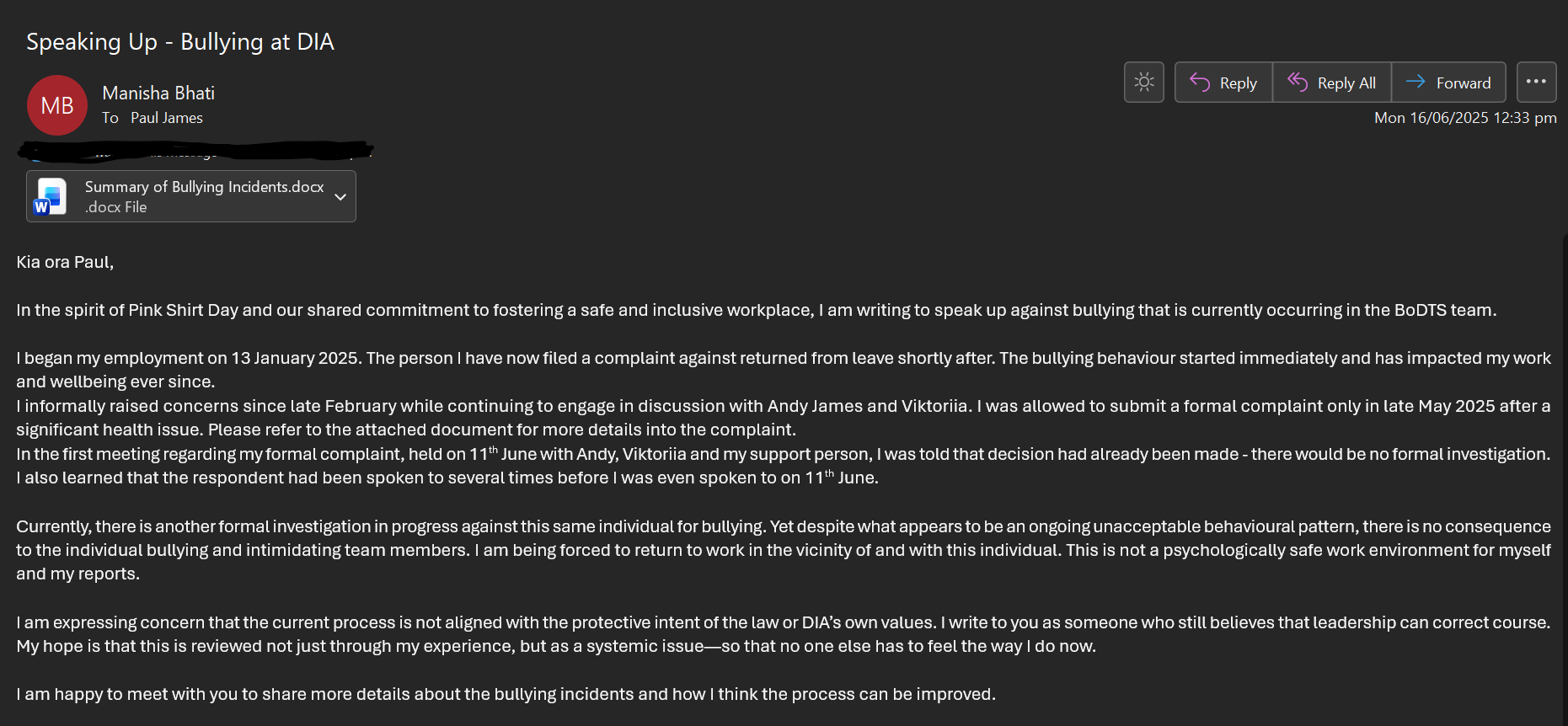
My email to Paul James on 16-June-2025
He replied on 18 June 2025. He thanked me for speaking up. He said he had appointed Richard Ashworth, General Manager of Government Digital Services Delivery, to look into the matter.
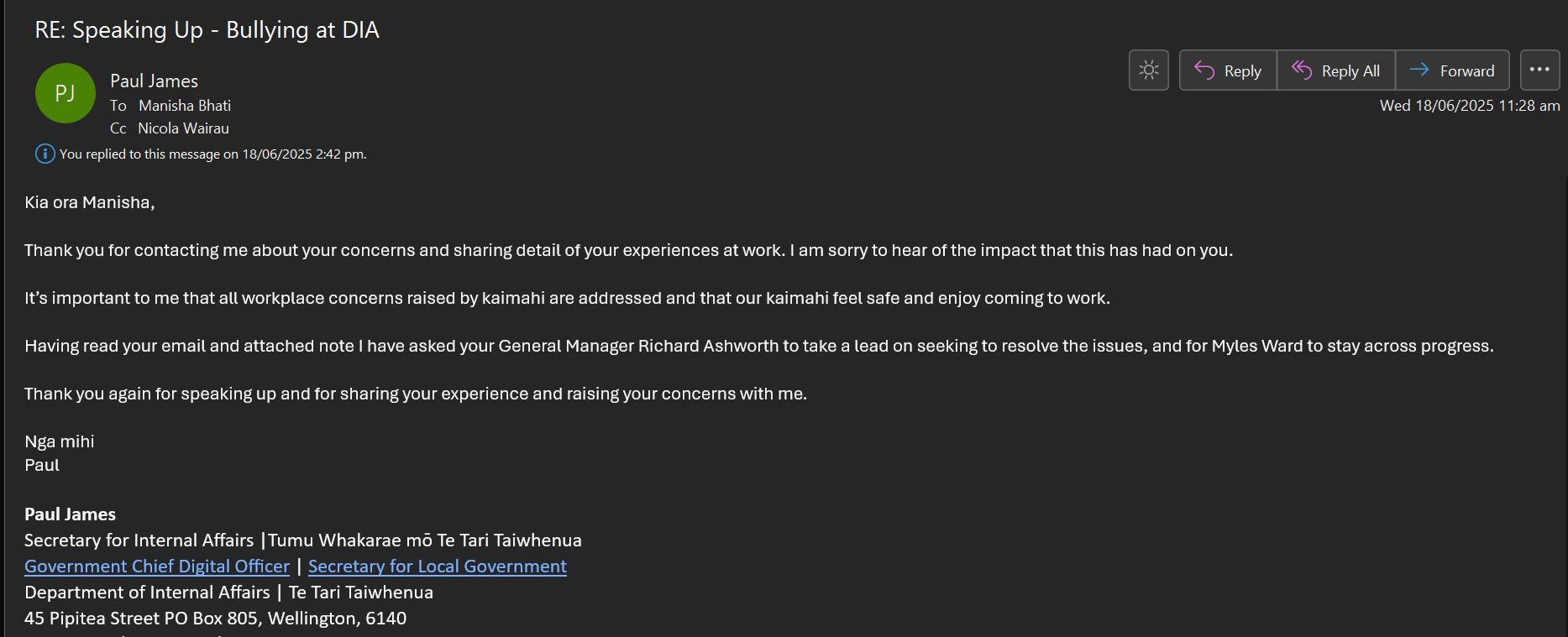
Response from Paul James
On that same day, 18 June 2025, three formal complaints were filed against me.
One from Andy James. One from Simon Dannefaerd, the person I had spent months formally complaining about. One from Kylie Matson, whose conduct I had also documented and raised concerns about. Three complaints, filed simultaneously, on the same day as Paul James's reply, against the person who had just written to the Chief Executive about being bullied. I have now learned that there is a term for this conduct 'mobbing'.
I also received, within 30 minutes of Paul James's email, a calendar invitation titled "HR Issues Catch-Up." There was no agenda attached. You can read about here - https://www.voicesworknz.org/blog/richard-ashworth-dia-case-study-part-6.
I was given two options: accept immediate special leave, or attend a suspension meeting two days later. No prior notice. No legal representative. No opportunity to prepare or respond. I had been told the meeting was a catch-up.
I have seen the messages between HR, Andy James and Richard Ashworth that show what was being discussed internally in the days following the 11th of June meeting to my email to Paul James. They were discussing whether I could be placed on leave without my agreement and what legal sign-off would be required to do so. I would like readers to look at those documents and ask themselves what word they would use to describe a process that begins with a complaint about bullying and ends, within 48 hours of reaching the Chief Executive, with the complainant removed from her role.
The word I use is Goonda-playbook. This is how managed-out works. The complainant is neutralised. The complaints against the complainant are filed and accepted immediately. The complainant is isolated, told not to contact colleagues, cut off from the workplace and from any ability to follow up. The person they complained about stays. The institution closes around itself.
Simon Dannefaerd remained in the workplace throughout. So did Andy James and Kylie Matson. I was placed on a leave that resulted in my termination.
I want to talk about what Paul James knew and when, because I believe he had an important role to play in my story.
I wrote to him personally. He personally replied. He personally appointed Richard Ashworth. Within 30 minutes of his reply, I had been ambushed in a meeting by Richard Ashworth and Viktoriia Bragina, placed on immediate special leave, and instructed not to contact any colleagues. Three complaints against me had been filed on the same day he responded to mine. I have never before seen senior managers behaving in this way, breaching their own organisation's Code of Conduct, running a process with no agenda, denying fair process, orchestrating simultaneous complaints, unless they are confident the institution above them will hold.
And that it did.
For nine of my fifteen months at DIA I was on forced leave. My lawyer was time and again ghosted for weeks at a time. I was isolated and could not follow up with the Chief Executive about what had happened as a direct consequence of writing to him. The Code of Conduct implemented on 30th March 2026 (https://www.publicservice.govt.nz/guidance/the-code-of-conduct-for-the-public-sector), states that the Chief Executive is accountable for the culture and conduct of the organisation.
I ask the questions I think any reasonable person has a right to ask. Did Paul James protect me? Did he uphold the policies of his own department? Did he honour the words he had put his name to? Based on everything I experienced, my answer to all three is no. Of course, Paul James could address these questions and show me otherwise.
There is something else about Paul James that belongs in this post, because this series is about where taxpayer money goes and he is the person who authorised how it was spent.
ARIS is the technology platform that sits at the centre of this series, the system that connects the process models of more than forty government agencies, that has been funded by public money for years. Paul James signed off on that system without the mandatory Certification and Accreditation process required for government technology of its kind. That is not an opinion. It is documented. And four years after that sign-off, the certification had still not been completed. This is based on the information available to me in June 2025.
The system ran for over four years without Multi-Factor Authentication or Single Sign-On, leaving critical security gaps that were only addressed by external contractors after we raised them. The most recent Health Check report, identifying critical vulnerabilities, was removed from DIA's SharePoint repository rather than shared with senior leadership or the Minister. A penetration test was conducted directly in the live production environment, in breach of standard security practice.
At the time ARIS was procured, cheaper and more secure alternatives existed. They were not chosen. Meanwhile, taxpayers were funding the full salaries of Simon Dannefaerd and Kylie Matson as system administrators, a combined cost of approximately between $200,000 and $255,000 per year, while simultaneously paying two Azimuth contractors to carry out the work that was part of the job descriptions of Simon and Kylie. Work paid for twice. With public money.
The real cost of fixing a broken system is not just financial. The real cost is transparency. When a system works properly, every decision becomes visible. Everyone has access to information about who chose what, on what basis, with what outcome. That kind of transparency is precisely what people who have misused their authority cannot afford. A Chief Executive who genuinely prioritises public accountability over institutional protection would have wanted to know about these failures. What I got instead was retaliation.
An OIA response references a prior case in which DIA spent approximately $913,000 pursuing an employment matter involving a whistleblower. That is public money. Authorised at a senior level. To put it in terms that mean something: it represents roughly eight to ten years of living expenses for an average New Zealand family. You and I pay our taxes and twenty to thirty percent of what we earn funds the public service. In my experience of what happened inside the Department of Internal Affairs, those same tax dollars were used to protect the institution from the people trying to make it better. Your tax dollars are still being used to fund an investigation which involves people no longer employed with DIA.
Earlier this year, my team was identified as one of those being transferred from the Department of Internal Affairs to the Public Service Commissioner's oversight. My role was part of that transfer. DIA dismissed me the day before the transfer. I will address the basis for that dismissal in a future post. I think readers will have a view about what it means that the institution moved to remove me at precisely that moment.
I am writing this at great personal risk and I know it. I expect legal threats to follow. I am writing it anyway, because the people of this beautiful country, the people who have written to me, who have shared these posts, who have quietly said ‘me too’, deserve better than leaders who spend public money protecting themselves from accountability while the systems built to serve ordinary New Zealanders stay broken. When every formal pathway closes, transparency is the only mechanism left. That is what this series is. And it is, without question, a risk worth taking.
The role of the PSA in this story will be addressed in a future post. If you have worked at DIA and have something to share, the contact form on this site is confidential.
