Where Do Our Tax Dollars Go: A Case Study (Part 6) - Blind by Choice

Source: Employment New Zealand employment.govt.nz. What fair process requires under New Zealand law.
This matter remains before the Employment Relations Authority. All claims are drawn from documented evidence forming part of those active proceedings.
In my last post, I wrote the hardest thing I have written in this series. This week, I want to tell you about Richard Ashworth, the person who disappointed me the most through this entire experience at DIA.
I want to be clear from the outset. Everything I write here is my experience of him. I am not inside his head. I do not know what he was told, or not told, or chose not to ask. What I know is what I lived. And what I lived with Richard Ashworth was the disappointment of being let down by someone I genuinely thought was an honest person.
Richard Ashworth was on the interview panel when I joined the Department of Internal Affairs in January 2025. As General Manager, he was the most senior person on that panel. He chose me as the preferred candidate. This is worth mentioning because it means that Richard’s first impression of me was that I was an excellent fit for the role Manager Technical Operations. I was told, in separate conversations with Richard, Fraser Buchanan, and Andy James, that Simon Dannefaerd had been considered for this role and had not been selected. The reason given to me was that he was assessed as not having the right leadership skills for the position.
Coming back to my role, I want you to understand what this role meant to me before I tell you what happened inside it. I had come from the private sector, from consulting, from environments where technology exists to generate revenue. This role was different. It sat at the intersection of technology and public service, the kind of IT infrastructure that exists to serve ordinary New Zealanders, people who will never know the names of the people building the systems they rely on. That is what I have always cared about. Using technology to help the person, the taxpayer, who is not part of decisions affecting them. When I got this role, I was completely and genuinely grateful.
Every time I passed Richard in those early months, I thanked him. Not out of obligation. Because I meant it. He had given me something I valued. And I was hearing through Andy James that the feeling was mutual. Richard Ashworth thinks highly of you. He is impressed. He likes you. I believed that. I had no reason not to.
In those early months, I also got on well with Andy James and Fraser Buchanan. I said as much in writing. I found them warm and collegial. I meant it at the time. Later, in formal proceedings, the Department of Internal Affairs quoted those early words back at me as evidence that nothing could have been seriously wrong. That because I had once described them positively, my later concerns must be exaggerated or invented.
I want to ask Richard Ashworth something directly about that. He is a General Manager. He has spent years in senior leadership. He has seen teams change, relationships shift, trust break down over time. Does he genuinely believe that how someone feels in their first month in a job role accurately reflects what they experience in their fifth or tenth? Because if he does, I would suggest that explains a great deal about what followed.
What I had not yet understood in those early months is how quickly a workplace can change shape around you when it decides you are no longer useful to it.
If you have read earlier parts of this series, you already know what was happening inside the team I had joined. What matters for this part of the story is that at a certain point, I realised I was not getting the support I needed from Andy. So, I did what I believed was the right thing. I asked Richard for a one-on-one meeting, referred to as a one-up meeting here in NZ workplaces. It is a skip level meeting that anyone can ask the senior leader who is higher than their line manager, often to discuss any issues they might be having that their line manager is unable or unwilling to resolve.
He set that meeting up as a confidential meeting. He came. He listened. He took notes of all the concerns I had.
I raised three things with him at that meeting. First, I told him I was not being allowed to raise risks formally, risks that were real and documented. Second, I told him I had been trying to make a formal complaint to HR about Simon Dannefaerd's conduct for four to five months and was being actively steered away from doing so. Third, I needed his support on the ARIS licence renewal, specifically around a technical approach involving separate tenancies for different public service agencies, which Andy James and the team were not supporting. I will cover the technical detail of that in a separate article, because it deserves its own space. What I told Richard plainly, as a starting point anyone could understand, was that there was no test environment owned by DIA. The team was relying on a test environment sitting with an external contractor, with no written agreement governing it. In a government setting, with public data and public systems at stake, that is not a minor operational detail.
Richard told me he would investigate it.
I left that meeting feeling, for the first time in a while, like someone senior was paying attention. That feeling did not last long.
The responses to my follow-ups got slower and then stopped. Every time I reached out, Richard evaded it and eventually asked me to take it to Andy. Andy was the very person I had come to Richard to escalate away from.
Throughout my tenure at DIA, I continued to bring things to Richard's attention through emails and follow-up conversations. At different points, I told him about a health check the vendor had been commissioned to conduct, a detailed thirty-five-to-thirty-six-page document I had uploaded to SharePoint. I had invited Richard to attend the meeting where we would walk through it with the vendor directly. Andy cancelled that meeting. And at some point, after that, the document disappeared from SharePoint.
I do not know who deleted it. What I know is that Simon Dannefaerd and Kylie Matson were pushing for SharePoint administrator rights at around the same time. After I was removed from my role, Simon was given the authority to negotiate the ARIS licence renewal. He was also given SharePoint administrator access. Neither of those things had anything to do with his stated role. I have never understood it, and no one has ever formally explained the rationale behind those decisions.
I gave him the information he needed to ask the right questions. At different times. In different ways. I kept trying even when responses stopped coming.
There was also this. The director-level reports coming from Andy James showed, for a long time, no meaningful risks. Standard reassuring updates. And then, at some point, the risks and issues section was removed from those reports altogether. I am asking a genuine question. Did Richard Ashworth notice? Did he ask why a programme of this scale had suddenly stopped reporting risks? Or had the reporting become so consistently calm that no one thought to question it?
I want to be clear about what I was asking of Richard over the course of those issues. I was not asking him to take sides or make enemies. I was asking him, as the General Manager for this very important programme to the minister Judith Collins, to pay attention. To look at what was happening in his organisation and exercise some judgment about it. In my opinion, the response was never of curiosity or accountability, but of avoidance.
By June 2025, I had reached the point where I felt I had no other option but to write directly to the Chief Executive, Paul James, about my concerns. After I sent that email, I sent a message to Richard on Teams and called him on his mobile. I wanted him to know what I had done and why. I left a voicemail that something was coming his way and that I needed to speak with him in confidence.
Richard had always responded to my messages before. He had set up meetings, replied to questions, been available. That had been the shape of our relationship, or so I believed.
The Teams message showed as read. He never replied. He never returned my call.
On 18 June 2025, I received an online meeting invitation from Richard. It was titled “HR issues catch-up”. There was no agenda. That meeting was held on Teams. Richard was there. Viktoriia Bragina was there. I was at home.
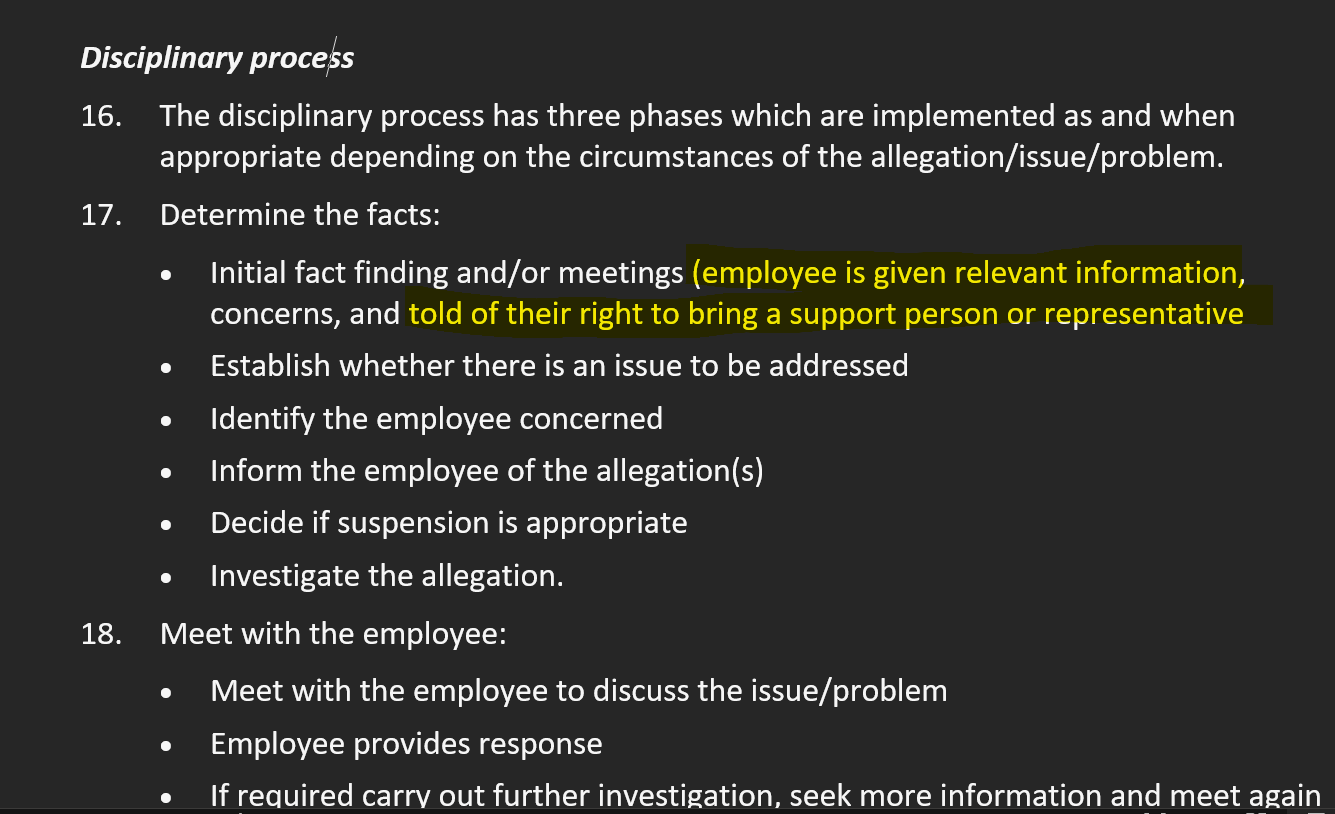
Disciplinary Policy - Department of Internal Affairs
As soon as Richard raised the matter of Andy's complaint about my private note, I said clearly that I did not want to be in this conversation. I had not known this was what the meeting was about. I had thought I was finally going to discuss my own complaints about Simon and Kylie. I did not have a support person, a PSA delegate or a legal representative. I said that. Out loud. To both of them.
Richard wrote in a subsequent formal letter that he did not witness or hear me say this. Viktoriia, he wrote, also denies it.
I said it. I know I said it because it was the only thing I could say when a General Manager and senior advisor from HR ambushed me. Richard even paused for a moment and looked at Viktoriia. And her words were this – you have no choice. When a manager in his team was being told she had no choice but to attend the meeting, Richard chose to ignore natural justice and fair process.
The meeting continued despite my repeated objections. I ended up on paid special leave.
