Where Do Our Tax Dollars Go: A Case Study (Part 7) - Lisa Gibson, New Girl Forever
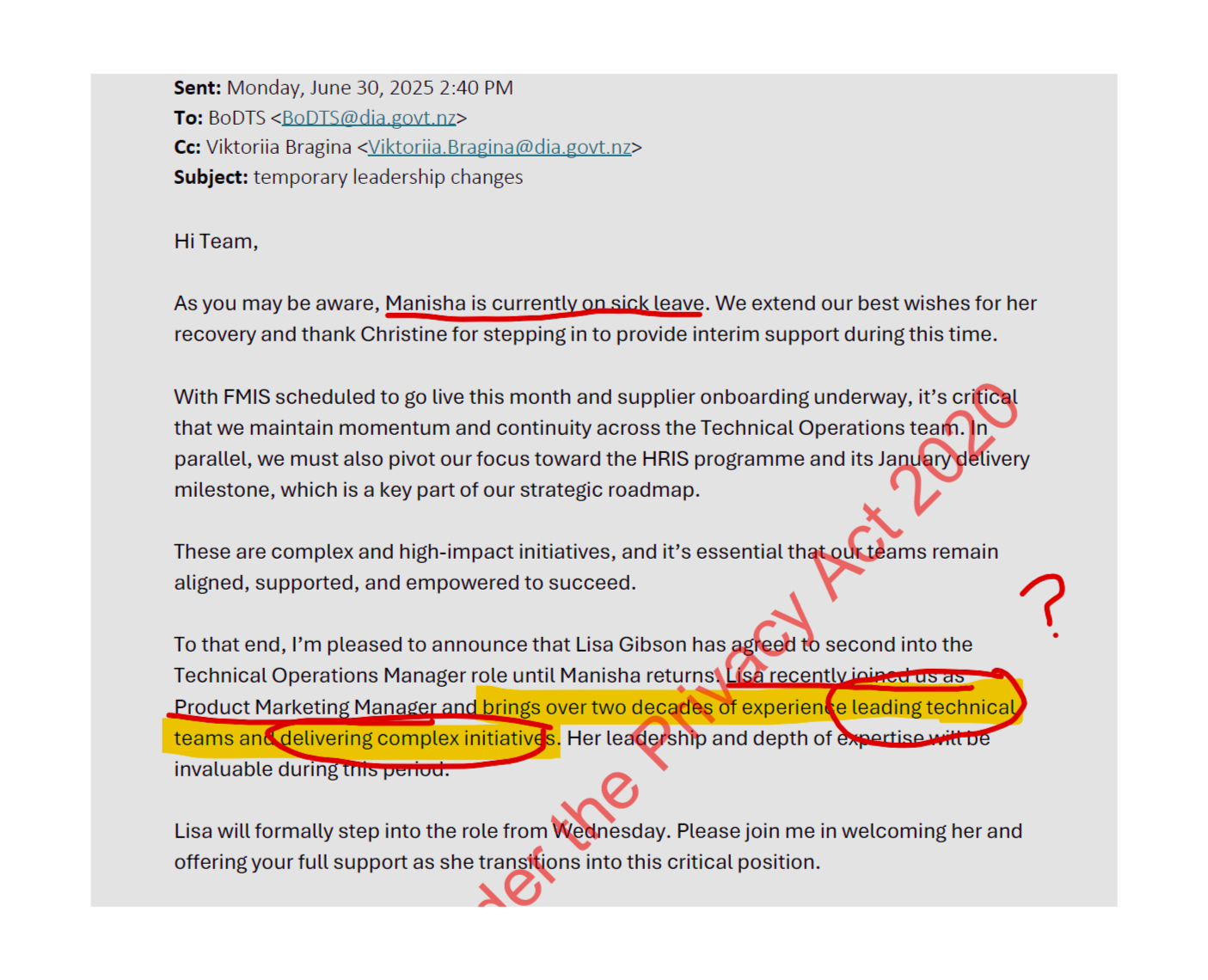
“Until Manisha returns.” Sure.
Note: This matter remains before the Employment Relations Authority. All claims are drawn from documented evidence forming part of those active proceedings.
In September 2025, Minister Judith Collins announced that the Back-Office Digital Transformation Services programme at the Department of Internal Affairs would save New Zealanders $3.9 billion over five years. (Read it here - Public service digital transformation accelerates | Beehive.govt.nz). That number was said publicly, with confidence, on behalf of a programme funded by the people it was supposed to serve.
This is a story about what was happening inside that programme at the same time.
A position called Product Marketing Manager had been advertised within the Back-Office Digital Transformation Services team. I was not on the interview panel for that first round. What I was told afterwards was that it had not gone well. The candidates who came through were not interested enough. The salary on offer, I was told, was too low for the level of the role. This was a senior position, requiring someone with in-depth experience.
And so, the salary band was elevated.
By the time the role was re-advertised, the midpoint of that band sat at approximately $145,000 a year. Of public money. In a team whose agencies were not choosing to engage with us. They were operating under a mandate from the Minister. Thirty-two agencies were directed to work with this team. Dozens more were strongly recommended to do the same. The government had already done the convincing. Whether this programme needed a product marketing manager at all is a question I will come back to.
Andy James, the Director, began setting up the interview process.
The first thing Andy James did was give an instruction. Only managers would sit on the panel. Nobody else from the team.
The second was a suggestion. In fairness, he said, the interview questions should be shared with all candidates in advance.
The third was a conversation he had with me directly. He told me that a friend of his would be applying for the role.
I need you to understand what that does to you.
I was going to be on that panel. The moment Andy James told me who Lisa Gibson was to him, something shifted that could not be undone.
I have hired for roles in my own team. I would never tell a panel member before an interview that a candidate was my friend. But when that information comes from the Director, there is an obvious power imbalance. You cannot unhear it. And you cannot be objective after it. The only reason to share that information before an interview is because you want the room to understand what is expected of them.
Based on what I witnessed during the interview itself, I believe I was not the only person Andy James told.
Around the same time, Andy James and Fraser Buchanan had a separate conversation with me about what kind of person this role required. The work involved going out to senior people across government agencies and bringing them on board with the programme. The argument they made was that those senior people would not respond well to just anyone. They would, as the phrase went, eat that person alive unless the candidate could speak to them in their language. And the person who could do that, I was told, was a white man.
I did not argue. This was not my hire. But I was not convinced, not for a moment. I was a brown woman. I spoke to agencies every day. Those conversations worked because I understood the technology, the systems, and what the programme was trying to achieve. Agencies did not need someone who looked a certain way. They needed someone who knew what they were talking about. What Andy James and Fraser Buchanan were describing was not a business requirement. It was their own bias dressed up as one. And as they explained it to me, I kept thinking that if these were the people who had been on my own interview panel when I joined DIA, I wondered whether they would have selected me at all.
I could not share any of this with my team member who came to me and said she wanted to apply.
She asked me whether she should put her name forward. I told her I would support her in whatever she decided, and that she was welcome to apply. But I also told her not to keep her hopes too high. I could not tell her the real reason. She deserved honesty. The most honest thing I could give her, without telling her what I had been told, was that caution.
Fraser Buchanan had been going back to her repeatedly, pushing her to apply even when she was hesitant. Eventually her application went in after the closing date. Then Fraser came to me and said he was thinking of calling her for an interview. I asked him whether her application met the requirements for the role. He said no. I told him we should not be calling her in. My reflection at the time was that it was a cruel thing to do. You do not ask someone to prepare, to show up, to give you their best, and then tell them no when you already know the answer before they arrive. He finally gave in. She was rejected before the interview stage.
There was a second internal candidate, from another team within DIA. They have been encouraged to apply by Andy James. They were shortlisted and invited to interview. They did not get the role.
From where I stood, looking at all of this, what the process appeared to be was a process designed to look like something it was not. Lisa Gibson was going to be hired. The other candidates were there so the process looked fair.
Then there was the third shortlisted candidate. She was a young woman joining the interview remotely from Australia. She had come third in the CV shortlisting. Before her interview was scheduled, Fraser Buchanan told me directly that he already had his top two candidates. I said to him that we should contact her, apologise, and let her know that we had found our preferred candidates and would not be proceeding. I know this is possible because it happened to me once in New Zealand. I had been scheduled for an interview, and the organisation sent me an email to say they had found their person. I was grateful for it. It was a kindness that cost them nothing and saved me time and hope. It was also the right thing to do with public money, not spend ninety minutes of two managers and a principal adviser interviewing someone when the decision had already effectively been made.
Fraser Buchanan told me that was not how things were done in government. The interview had to go ahead. Whatever I said, he had made up his mind. The interview continued. That young woman came on screen from Australia, answered every question, and had no idea she was not being seriously considered. From her responses, it did not appear to me that she had received the questions in advance, the ones Andy James had suggested should be shared with all candidates. I cannot say this with certainty. But I noticed it.
Before I tell you what happened in that interview, I want to tell you who was in the room.
The panel was Fraser Buchanan, Farisha Begg, a principal adviser from Fraser Buchanan's team, and me. The third manager from Andy James's team, the one who should have been there under Andy James's own standing instruction, was not present. No explanation was offered for his absence. Farisha Begg was not a manager. She did not have specific context for what the role required. I did not understand why she was there until the interview itself.
Near the end of the interview, Lisa Gibson asked what the best thing about working in this team was.
Before Fraser Buchanan or I could respond, Farisha Begg answered. Immediately. She talked about Andy James. At length. She described the Director in terms that made the expected answer clear to everyone in that room.
Fraser Buchanan followed. He agreed. It seemed like there was nothing better in the team than the Director, and I wondered if these words would have been said if the candidate being interviewed was not a friend of the Director.
I said something about working for the taxpayer. About using technology to serve ordinary New Zealanders who deserve better public services for the money they contribute. I meant it. Nobody in that room seemed to share the sentiment.
Then I asked Lisa Gibson how she had found working with Andy James. She said he was nice. And then she added that he was also human. In a room where two people had just spent several minutes describing the Director as the best thing about working in this team, that was the answer she gave. It did not seem to be a rehearsed line. To me, it sounded like something she would say about a friend, not about a colleague.
Lisa Gibson received forty out of forty points for that interview. That is a rare score. In an interview panel, the final score is typically arrived at through discussion among the panel members. I was not surprised by that score.
Andy James conducted the final round. Based on the email exchange I observed, his approval came through very quickly. What that assessment consisted of, only Andy would know.
Later, the team got to see Lisa Gibson's skills in practice. A basic ticketing system needed to be set up for the team. It took weeks. The person helping her build it could not get a clear answer about what data was needed. Every time he asked, she could not provide clear requirements. That person was the other internal candidate who had not been selected for her role. The irony of that situation is not lost on me.
Lisa described herself, in various exchanges during this period, as the "new girl". Someone who did not know much about technology. Still finding her feet.
I had been on medical leave earlier in May 2025. I came back to work briefly. On 18th June 2025, I was placed on paid special leave. The circumstances of that will be covered in later parts of this series.
On 30th June 2025, Andy James sent an email to the team announcing that Lisa Gibson would be Acting Manager, Technical Operations. My role. HR was informed she would be doing pastoral care.
For those unfamiliar with the term, pastoral care in a workplace context means looking after the wellbeing of the team. Checking in on people. Making sure they are okay. It is not a technical function. It is not a managerial function. It does not involve hiring decisions, interview panels, or appointments.
And yet, to my knowledge, Lisa Gibson has been part of interview panels. She has been involved in hiring decisions. She performed three roles in the process that led to Kylie Matson's appointment as Lead Process Analyst (More details in this post - Kylie Matson, Simon Dannefaerd & Andy James: DIA Case Study Part 4 — Voices@WorkNZ ). These are not pastoral care functions. These are some of the functions of a Manager Technical Operations.
There was already someone from my team filling in for me. She had been doing it well. Andy James had acknowledged her contribution in writing. She knew the platforms, she knew the programme, and she knew what needed to happen next.
She was passed over without reasonable explanation.
I have acted above my own role before. When I did, I included the person I was covering for in everything. Weekly updates. A clear record of what was pending. Everything they needed to walk back in and continue without losing a step. That is what acting means. You are holding something for someone. You keep them connected to it.
Lisa Gibson never sent me an update. Never included me in a team meeting. Never created a handover plan. Never communicated to the people I had been managing that I was still the substantive holder of the role. My access to team communications was removed. The programme I had spent months building moved forward, and I was outside it.
I was the only brown woman manager with a team reporting to her across the entire All of Government Services Delivery division at DIA. That is the person who was removed from her role and replaced, without any process, without any declared conflict of interest, by the Director's friend.
They had told me this role needed a white man because agencies would not respond to anyone else. In the end, they hired a white woman.
For a period after her appointment, the word Acting disappeared from Lisa Gibson's email signature and title. When my legal representative raised this and provided a screenshot as evidence, DIA leadership denied it had ever been absent. The screenshot was real. The denial was made regardless.
When the team transferred to Te Kawa Mataaho Public Service Commission on the first of April 2026, internal documents identified two Manager Technical Operations positions moving across. Not one acting and one substantive role awaiting resolution. Two positions.
Lisa Gibson has now been in my role longer than I was. She has never appeared for an interview for it. She has never been assessed against its requirements. I went through a full recruitment process, was selected on merit, and was given the role. Lisa Gibson was handed it while I was on leave, supposedly 'acting' in my absence.
I will let you draw your own conclusions about what that tells us.
It has now been more than eleven months since I was placed on leave. For all eleven of those months, Lisa Gibson has, to my knowledge, been performing both the Product Marketing Manager role and the Acting Manager Technical Operations role at the same time. Two full-time positions. One person. A question worth asking is whether she was being paid for two roles.
This team has now been in the picture for approximately eighteen months. In that time, to my knowledge, there is no published report showing what has been delivered. No compliance framework showing which agencies are meeting their obligations and which are not. No measurement matrix showing progress against the savings Minister Collins announced. No strategy that has been made public. No roadmap. Nothing that a taxpayer could look at and say, this is what we have received for our money.
I understand that in the early years of a programme like this, the savings are smaller and the foundation work takes time. That is reasonable. But there is always something to show. A direction. A baseline. A way of measuring whether you are moving the right way. After eighteen months, this programme has none of that visible to the public.
The Product Marketing Manager role, the one so urgently needed that the salary band had to be elevated to attract candidates, has not produced any visible product marketing. There are no products. There is a government mandate. Those are different things. That role has not been performed by anyone.
So here is a simple question. If Lisa Gibson is performing two full-time roles simultaneously, with no visible delivery in either, which one is redundant? And if one of them was always going to be redundant, what did the public get for the money spent creating it?
In September 2025, Minister Judith Collins told New Zealanders this programme would save them $3.9 billion. That promise belongs to all of us.
Show us the work.
In the next article, we look at what the tax dollars funding this programme have actually produced, and what accountability looks like when the reality does not match the promise.
